Sunday, May 26, 2013

A Ballet for (mostly) Very Short Dancers: The Hobbit in Three Acts


The traditional three-act story ballet is a timeless form. From Giselle to Dracula, the appeal of the danced narrative has endured the slings and arrows of cruel modernism and the arch laughter of the po-mo. Since story ballets are the money-making bread and butter of most ballet companies and are especially crucial to the well-being of small, regional or civic companies, and because of the recent success of such fare as The Lion King and The Little Mermaid, I propose that a series of ballets based on popular fantasy literature be developed for performance by your typical small, semi-pro or amateur ballet company; heavy on roles for short people (e.g., child performers).  I envision such hits as The Harry Potter Suite (a condensation of the seven novels); Star Wars Lake (an interlude based on fan fiction); and of course Where’s Waldo Now? (in which audience participation plays a critical role in the form of texting in guesses as to what scene from which famous ballet Waldo has invaded).

Not this kind of hobbit.
Just to give a sense of how this would all work, here are program notes to The Hobbit: a ballet in three acts.

ACT I
Scene 1: Bag End

Bilbo (likely played by a pre-adolescent girl) enters, capering youthfully, but when he realizes that the audience is watching, he assumes a more ponderous and mature air. We see him being domestic; a dance with a broom as his partner is whimsical, while a short coda featuring a dishrag and some teacups charms us.

Gandalf appears, upstage left, in a cloud of smoke. A great deal of pantomime ensues, its meaning obscure to all but those intimately familiar with Tolkien. Gandalf performs the famous “pipe dance” solo.

Exit Gandalf. Bilbo dances a mournful waltz.

Scene 2: The arrival of the Dwarves
The dwarves arrive in twos and threes; they dance wildly around the stage, throwing props such as plates and antimacassars as Bilbo flutters about ineffectually.

Thorin dances the famous “King of the Dwarves Variation” and with help from the corps of dwarves (played by small girls wearing beards and pointe shoes), relates the tale of the Dwarves of Lonely Mountain, complete with a battle scene involving a dragon.

Scene 3: The departure
A party on the village green features variations representing the different races of Middle Earth; entertainments include the Waltz of the Wood Elves, the Ranger’s Rondo, the Gondor Gavotte, the Orc Fire Dance, and the Hobbit Pas-de-Trois. If you are not familiar with this episode from the novel, just deal with it.

Bilbo and the Dwarves leave Hobbiton to the distress of the Hobbits. Some of Bilbo’s relatives are eager to occupy Bag End. Gandalf appears upstage left in a cloud of smoke, and the lights go out.

ACT II
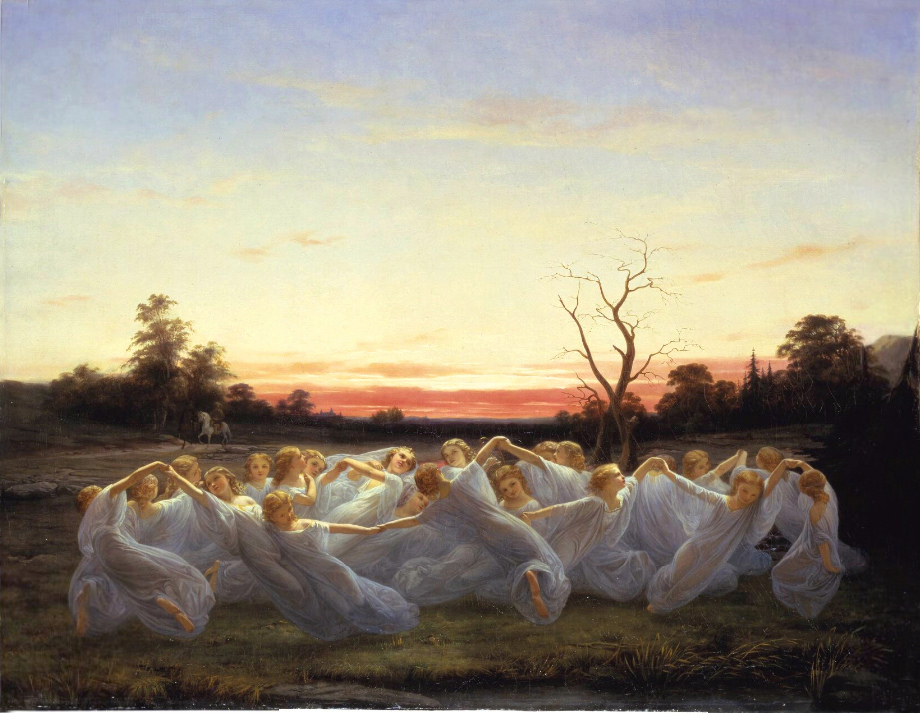
File:Ängsälvor - Nils Blommér 1850.jpg
Nils Blommér, Ängsälvor, 1850 -- appropriately Nordic (Wikimedia Commons)
Scene 1: Un ballet blanc
Bilbo, alone, wanders onto stage and lies down. He falls asleep. To the haunting strains of harp music, the corps-de-ballet enters in a slow and stately procession, all in white. Who are these ghostly ladies? What are they doing in The Hobbit? How does this fit into the story? Stop asking such pointless questions.

Scene 2: The Gollum Pas-de-Deux
For the purposes of this ballet and in order to accommodate the usual male-female ratios of civic ballet companies, the character of Gollum has been transformed into an elfin maiden named Annabelle. Annabelle rescues Bilbo when he is lost in the mountains; they dance a touching pas-de-deux which culminates with Annabelle bestowing a magical ring on Bilbo, etcetera. Since we are not planning on setting The Lord of the Rings as a ballet, this total derailment of Tolkien’s plot doesn’t matter, so enough with your objections. Just applaud when Annabelle performs eighty-four fouetté turns with the help of a little CGI and video editing.

Scene 3: The Eagle Scene
Set to the Steve Miller Band’s “Fly Like an Eagle,” this is a “lyrical-modern” piece in which the dwarves, Bilbo, and Gandalf take flight using stage magic (harnesses) and a bunch of people in really ugly costumes (goblins) roll around on the floor and gesticulate wildly.

ACT III: The rest of the story
Scene 1: The Wood Elves
Nothing much actually happens during this scene, except that there’s some great choreography for the corps, some good solos for senior company members, and we don’t have to watch Bilbo and the Dwarves do much dancing. If you’ve read the book, you know what happens with the Wood Elves anyway. The scene ends with Bilbo and the Dwarves being rolled offstage in barrels by the water sprites (we reused the Dewdrop Fairy costumes from our Nutcracker).

Scene 2: The Lonely Mountain
Bilbo enters the mountain. There’s a lot of stage business involving a giant mechanical dragon. Oh yeah, and Bilbo is invisible, so we don’t actually have to see him dance. The Gold Coin Fairies, a group of our youngest students, are incredibly cute as they tumble about on stage and wave to their moms and dads in the audience.

Scene 3: Laketown
Heartwrenching drama as Smaug nearly destroys the town. Heroics. Throw in a girl who’s not in the book as a love interest for the guy who shoots the dragon. A big wedding dance with more “ethnic” variations, including the memorable “Toast Fairy Variation.”

Coda: Hobbiton
Bilbo returns home – he dances a jolly pas-de-deux with Gandalf for the last time, and throws his unpleasant relatives out of Bag End. He slips on the ring, and vanishes.

Hey look what The Guardian published just days after I posted this! What's your fantasy story ballet?
Toast fairy... fairy toast... big diff!

Thursday, May 23, 2013

Plus ça change


Choreography, along with dance criticism, strike me as two of the most difficult art forms to master. Choreography, because it demands that one imagine the possibilities of body-time-motion-sound relationships within a particular vocabulary of movement in order to express usually quite abstract ideas; also, most choreographers have to be able to imagine what bodies other from their own might be able to do. Dance criticism, because it requires of the critic the ability to both immerse herself in the role of dance-spectator and to later recall the stream of fleeing perceptions occasioned by the work and to retrospectively critique them in some kind of coherent, streamlined way. This is why Joan Acocella is one of my heroines. She does this panache and precision
Joan Acocella
.
So, being neither a choreographer nor a dance critic, I am still going to attempt to talk semi-intelligently about Innovations the showcase of new choreography performed by Ballet West that I saw last night at the Rose Wagner Theater in Salt Lake City. I should start by saying that I thoroughly enjoyed myself; I went with my mom, who is visiting town, and a group of women from my ballet class, including the instructor. We had a nice dinner out, then walked through the relatively balmy evening to the theater, which is a lovely, small and very modern space, mostly used for drama and for screening Sundance films. The intimacy of the theater certainly contributed to the feeling that the audience was somehow in cahoots with the performers – an impression heightened by the enthusiastic hoots of approval from a group of audience members who were obviously friends and familiars of the company members.

Christopher Rudd and his lovely wife, Christiana Bennett
The program opened with Trapped, a “revival” of a piece by one of the company’s senior principal dancers, Christopher Ruud; it wasn’t clear to me from the program notes when this had originally been performed, but so be it. Ruud is the artistic director of the development company, and is one of those danseurs of the Apollonian rather than the Dionysian type – that is to say, he’s not particularly tall, but very muscular, with a broad chest and trim hips, a somewhat Byronic head of dark hair, and the kind of handsome face that ages well. I give these details not to dwell on his manly beauty, but rather to suggest that there is some connection between his physical type as a dancer and his choreography. Thus: he is broody, explosive, more athletic than graceful, intense, and bundled with muscle. His choreography for this piece is, likewise, emotionally charged, rhythmically staccato, almost gymnastic at moments, and tinged with intimations of violence. 
Would you like some angst with  that?
The piece begins with the curtain down, and the sound of someone striding heavily and quickly on stage. As the curtain rises, a crowd of dancers is revealed – they’re all standing facing in various directions, arrayed across the stage somewhat at random. Around them walks a woman (Katherine Lawrence), dressed, like the rest of them, in a white tank-style top and bicycle shorts; she is the only one moving, and her movement is simple and vernacular – an angry, heavy-footed, stride with the head thrust forward on the neck. When the music begins, she summons movement (or so it seems) from one dancer or another; these are brief, highly individualized, complicated little tangles of steps from which the dancer returns to stillness. In a neat turn, the first dancer to move is joined by a second in the second “pass” by the angry woman, and then in the third pass, dancer #2 is joined by a third, while dancer #1 remains still, and so on, until everyone has done their thing. Meanwhile, the angry woman, in her clockwise perambulations, inserts into her walk these agonized passages of writhing gesture and stuttering pointe work – the control it takes to look as if one is at the mercy of some kind of possession or seizure while still maintaining the center-strength necessary for a high-speed forward bourrée is not to be sneezed at, and Lawrence pulled it off. The whole first movement involves this large group of dancers moving in increasingly complicated patterns either as a group or in male/female pairs while the angry woman grows more and more despairing and frantic. The stage, lit as if from high, sun-filled windows, has strong bands of light and shadow and a disconcertingly asymmetrical  enclosure of black cloth, increasing the sense of confinement and angst.
I just play one on TV.
Ruud embedded three pas-de-deux in the first movement. I would characterize the partners’ relationships in each as successively icy, abusive, and mutually aggressive; given that the angry woman is always there as a sort of narrator-like presence, these pairs seem to embody perhaps her history, perhaps her perception of her interactions with men, while the relentlessly marching corps that forms and reforms as each new couple takes shape are ominously indifferent to her distress. Of the three pas-de-deux, the most striking was the central piece, performed by the always-fascinating Allison DeBona; Ms. DeBona plays herself on the silly but nevertheless irresistible TV reality show, Breaking Pointe as a career-focused, somewhat cold-hearted, insecure and ambitious vixen.
As an actress, she is quite convincing in that role, but the fact that it is acting was highlighted by the degree to which in this role she performs a completely different persona. Here, she is the reluctant partner to the pushy, show-offy male, letting herself be picked up, thrown, twirled about, but then falling into a kind of regretful stillness that verges on despair. The choreography here was really a little uncomfortable; the force exerted on DeBona’s body as she is pushed backwards along the floor on the tops of her feet, hanging in her partner’s arms face down, her upper torso collapsed but her lower body stiff, hints strongly of male violence against women.
Scene from Ghosts of Violence, a ballet that is actually about violence against women.
Q.E.D.
Madness and death!
In this sense, Ruud is not particularly doing anything new or groundbreaking. Ballet can be violent towards women’s bodies; not only does it carry with it a long history of self-starvation, emotional abuse by sadistic ballet masters (and mistresses), the grueling and sometimes cruel regimen of training, injuries, the horror of pointe shoes, but it also quite often represents and romanticizes violence against women – poor Nikiya, bitten by a snake, Giselle, collapsing from the wound of love, Juliet, taking her own life, and so on and so forth. Even non-narrative ballet seems to revel in exploring the limits of the ballerina’s fragility and strength – Agon, for example, has those really combative, violent passages, especially in its pas-de-deux. And this got me thinking – is Trapped a commentary on the psychic damage implicit in traditional ballet forms and narratives?  Or is it just an exploitation and exaggeration (less critical than reactionary) of that dark subtext? I found the second movement, a solo by Lawrence, in which she seems to dance out her emotional and psychological collapse (and possibly self extinction – there is this repeated motif of her walking around her own arm, planted with a flat palm on the floor, that looks like she is drilling down into the earth, perhaps hoping to vanish there) moving and technically very impressive, but in the end, it’s the same old story – girl dances herself into madness and death.

This is what happens when you Google "Star Trek Ballet"
Two pieces by young company members (both male) reflected Ruud’s influence in terms of incorporating incredibly tricky footwork, athleticism, and show-stopping lifts and jumps. The first, Mechanism, by Easton Smith, had a Studio 54 like setting that felt a little at odds with the Bach Violin Concerto No. 5 in F Minor (BWV1056); as a continuous stream of dancers traversed two “catwalks” of light and performed a series of individualized movements during their time in the light, I was impressed by their agility and athleticism, and again by the complexity of the sequences, but at the same time it felt a little like a défilé de mode with particularly acrobatic models. Perhaps if the costumes had not reminded me so strongly of Star Trek (black jazz pants, silver hip belts, sheer or partly sheer black tops) I would have been able to get past the disco feeling of it all; certainly, when the dancers moved into a series of pas-de-deux and –trois, there was plenty to be impressed by; the throws and lifts showed the men’s incredible strength and timing, and showcased the trust that these dancers must have between one another. More than once I was unable to stifle a gasp as a ballerina was tossed, spinning, through the air, like an ice-skater, but without the whole business of landing on slippery ice. Had she not been caught, and caught well, it would have been a disaster. I can only imagine the nervous laughter at rehearsal when these moves were first set.
The problem, in the end, is that when ballet becomes too much about the gasp, it stops really being ballet and becomes, well, disco, or So You Think You Can Dance, or Vegas-style showmanship. The whole conceptual angle that makes dance interesting goes up in smoke, and I start to get a little bored. Thus, the thirty-two fouettés in Odile’s solo in Swan Lake only really work if the rest of the ballet has been staged to make them seem like an expression of her character (brilliant, aggressive, a show off); if Odile is just Odette in a black tutu, then it’s b-o-r-i-n-g (one of the things that Darren Aronofsky got right, surprisingly, in Black Swan, was that Odile has to be a real psycho). Essentially, the throws and the disco lights and the fashion-show setting, which could have been staged as a wry comment (ala Twyla Tharp’s In the Upper Room which seems to me like a critique of her own impulse to be more Broadway than Broadway) on popular uses of dance, of the body, of performance, turned into the sort of thing it was imitating, Entertainment. The whole thing had a gimmicky feel to it, which was too bad, because the dancers were really fantastic and it was also clear that they were having a great time (who wouldn’t, at a disco?) executing the incredibly challenging choreography
.
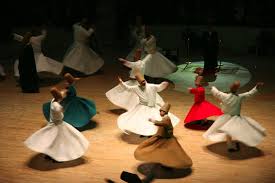
Not this.
Another piece with a strong dose of spectacle, Spun, by Adrian Fry, transcended its own gimcrackery beautifully. Inspired by Ray and Charles Eames’ wonderful short film, Tops, to music by Ólafur Arnalds (an Icelandic composer), it explored the theme of spinning, without getting to trite about it (there were chainé turns aplenty, but not too many – other circumambulations, loops, revolutions, and rotations were expanded upon in interesting ways). Anchored by Elizabeth McGrath, who has an unusually earthy presence for a classical ballerina, Spun gave the dancers the chance to show their individual strengths through some lovely ensemble work. It really captured the whimsy-flavored but ultimately serious character of the Eames’ film, which has always been one of my favorite shorts – it’s a kind of koan based on the idea of a very simple toy that is endlessly entrancing to adults and children alike, a kind of eraser of social distinction. The use of short lengths of silvery ribbon to connect partners by the wrist in the pas-de-deux sections could have been hopelessly gimmicky, but it worked, not entirely without a hitch (there were certain passages where the sketchiness of the device showed through), but well enough not to distract from the dance.

The lovely Ms. B.
Equally respectful of its sources was Christopher Anderson’s short ballet, Behind Closed Doors, set to selections from Bach’s solo violin Partita no. 1 in B Minor (BWV 1002) and Sonata no. 2 in A Minor (BWV 1003). More classical in its vocabulary than the other three pieces by corps members, and perhaps therefore more influenced by the company’s turn toward Balanchine repertoire in recent years, this work was also the most musically sensitive of the evening. The violinist stood downstage left, in front of the dancers, who first appeared silhouetted against the  softly luminous back screen, standing in pairs (well, three pairs and one solo). I had the fleeting sense memory of watching Indonesian shadow puppets as their limbs made complicated, anatomically impossible patterns together; each grouping’s choreography was unique – thus one pair of two women partnered each other in very different ways from the two male/female pairs, while the solo woman’s gestures seemed almost a punctuation mark to the complex grammar of the others’ poses. This was also the only time we got to see the flame-like Christiana Bennett on stage, but even that brief appearance was worth the ticket price; she just flows like water.

Henderson Smith: Has legs, will travel.
The final piece on the program was by a much more seasoned choreographer, Jodie Gates, who is the head of the dance program at USC and has an impressive list of accomplishments in her long career as a ballerina, teacher, choreographer and dramaturge. Unsurprisingly, her Mercurial Landscapes was more abstract, high-concept, and developed than the other works on the program. It also had the feeling of having been more rigorously edited; though there were definite motifs in the highly neoclassical choreography, the reliance on repetition was less visible. Set to an annoying score – selections from a “recomposition” of Vivaldi’s Four Seasons by Max Richter – the dance sometimes transcended the banality of Richter’s somewhat lazy renditions of the Baroque chestnut. Like Mark Morris (do I mention him at least once in every post?), Gates seems to have a nice feel for the movement of the old music (a fact somewhat obscured by the reworkings), though with her reliance on the tropes of pas-de-deux, corps, solo, the structure of the work is far more akin to Christopher Wheeldon – a fluid interlude featuring Haley Henderson Smith and Beau Pearson reminded me, in tone more than vocabulary, of the second movement of After the Rain. Though it was lyrical and well constructed, the costuming for this world premier was almost the best thing about it (beside Henderson Smith’s beautiful, perfect feet and long, bare legs); chilly, shimmering metallic fabrics in shades from ice blue to cool copper clung to the dancer’s bodies and gave them a, well, mercurial appearance. The use of stage lighting to expand and contract the space of the dance also worked well, and gave play to the notion of “landscapes” on what was otherwise a bare, black stage.

PNB's Next Step is a program dedicated to new choreos.
The best thing about the evening (aside from the company with which I was fortunate to share it), was that Adam Sklute, the artistic director of Ballet West, has made this commitment to allowing his dancers to develop as artists working with and as choreographers who are pushing the envelope of “classical ballet.” This is a trend among directors of major companies, and I think it is to be applauded, and loudly. When Jennifer Homans lamented the decline and announced the inevitable and impending death of ballet a few years ago in her (otherwise perceptive and intriguing) Apollo’s Angels I think she missed out on this new receptiveness on the part of senior choreographer/directors and audiences alike to seeing works by journeyman (or, one hopes, journeywoman) choreographers brought to the stage. Not everything will be of equally enduring stuff – I would not particularly hope to see Mechanism ever again. But I know I could watch Spun multiple times, and I think Mercurial Landscapes could grow on me; I would guess that there’s an audience (young, angst-ridden themselves) who might really warm to Trapped even if it’s not so much my thing.

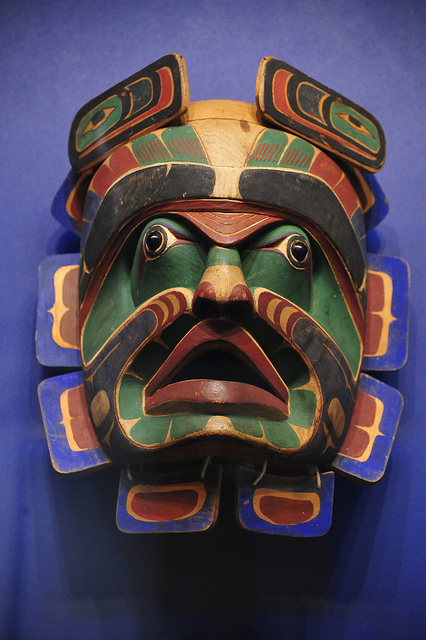
Northwest Coast Indian dance mask. Credit: asterix611/FlickrI remember distinctly that as a young ballet student I would sometimes come up with ideas for ballets I wanted to set; I wrote them down in my journals, complete with notes on the music, a sort of ad hoc dance notation, and ideas for the costumes, sets, and lighting. At the time, I had no idea how one would make such a thing come to life.  I wish that I had been exposed then to this kind of encouragement of young choreographers and this interest in experimentation. As it was, the one time I actually got to realize my imaginative schemes was in fifth grade, when as part of a social-studies unit on Native Northwest cultures, I put together a ballet based on a Coast Salish story. I cast my friend Johanna, who was already in the top class at PNB, as the heroine. My non-ballet-trained friends got parts that involved moving like animals or wind… very modern. I don’t have very clear memories of how it turned out, but the process was so great. My dad, who was not a dancer and knew next to nothing about ballet or theater, was so into the whole thing; he got me a Salish-English dictionary, so that we could give the work an “authentic” name (we called it Chembesh Kabahai, though I cannot for the life of me recall what this was supposed to mean – you have to understand that Salish is notated using Americanist phonetic notation, which is a means of representing the very non-European phonemes of north American native languages (e.g., xʷləmiʔčósən is the name of the Lummi language). So much for my career as a future Nijinskaya.

Women make ballet too: Emery LeCrone
Anyhow, kudos to Sklute and his crew for an evening of challenging, surprising, and sometimes sublime moments. I look forward to future editions of Innovations, especially when they will feature some of the women from the company in the driver’s seat. 

Just to beat that old gender horse a bit, I recently read an article focusing on works by several women choreographers that drew my attention to the fact that fewer than 10% of works performed by professional ballet companies in this country in 2011 were by women choreographers. Ouch! Modern dance has always been so much more open to our fair sex in this regard. In 2010, only four women were artistic directors of big-budget companies. It's not as if ballet is alone of the classical art forms to suffer (and it does suffer) from the dearth of women in the upper echelons of management; classical symphony orchestras with women artistic directors, for example, are hardly a dime a dozen. Maybe it's the very classicism of these art forms that acts as something of a drag... just to quote something that's been in the meme-o-sphere of late,  "So we beat on, boats against the current, borne back ceaselessly into the past."


Friday, May 17, 2013

Dancer Pose


"Yoga is like the pothead cousin of ballet." --Hally Marlino (yoga teacher and blogger)

I went back to yoga class today -- I've been an indifferent attender this spring, between one thing and another, but this particular class is always a pleasure -- it's not "restorative yoga" explicitly, but the practice is very calming and centering, and not at all about getting all sweaty and sore. I definitely needed a dose of organ-wringing and hip opening too: I have not been eating very well and I have been sitting around a lot, working on the computer. (Speaking of sitting around on one's derriere, I just read the article in this week's New Yorker by Susan Orlean about the treadmill desk. I need one of those!)

What is so great about yoga is that it does not have to be, should probably not be, goal oriented in the sense that there is an asana that you are going to get right, damn it, or tear your hip flexor trying. I may have gotten into yoga with a goal or goals in mind (strengthen my core, become more flexible, find a way to deal with stress, take time out of busy busy busy for breathing), but  when I'm actually practicing, that's all very far away. I think I like yoga class as opposed to my home practice largely because I am absolved of even having to make any decisions about what to do or how long to do it. Today, as I was hanging out there in Pigeon, really feeling it deep in my hip sockets, I thought "Wow, I would never hang out here this long if it were up to me... but it's not up to me." Of course, I could decide to move out of the pose, if for example I was in actual pain. But with yoga it's more an intense sensation that is not pain but that the brain might think is pain if it were screwed up with anxiety about something, or were distracted by the next thing coming down the pike.

Of course, lots of people bring a very competitive, aspirational mindset to yoga; they WILL get fully into break-my-sacrum-asana if it kills them. But I think that kind of person gets bored with it if they don't get injured. Yoga is (and I say this approvingly) massively boring from a goal-oriented standpoint. The changes it crafts in one's body are deep but so gradual and incremental that you hardly notice them until you've been at it for years; my nose still doesn't bump down on my knees when I stand in forward bend, and maybe never will. As the yoga instructor said this morning, "It's not about making the picture of the pose with your body, but about your intention to shape the pose." I love that even though it is obviously a movement-based practice, it is ultimately about what's going on in the consciousness and not about how that is expressed in the approximation of some formal norm in terms of the visible, outward, body.

Ballet, while it can be at times almost as purely in-the-moment as yoga, and certainly benefits from the dancer's presence in her body and indifference to before and after the dance in that instant, is more about making the picture of the pose with your body.Thus, it is more goal-oriented and outward in its nature.  Just last night, I was mentally going over this year in my dancing life and thinking about what I've accomplished and what I would like to work on going forward; and that's okay, with ballet, because there is that element of perfection-seeking to it. I have never, and would never, do this kind of self-evaluation and stock taking with yoga, though I am sure some people do and maybe even it can be done productively -- it can be an art form, too, I suppose (witness pictures to follow -- if they're not about making a picture of the pose, I don't know what is). Which is not to say I don't think about how I could, say, be more comfortable doing back-bends, or learn to really hop through from down-dog to a seated position.

Which brings me to Dancer Pose, or Natarajasana if you want to get all Sanskrit about it (नटराजासन if you really want to get all Sanskrit about it). This is one of those asanas that people really like to look at -- it shows up all over the place in what I'd call the popular iconosphere of yoga. Inevitably, the bodies performing the pose in this genre of imagery conform to certain ideals of beauty that can feel a bit oppressive to those of us whose bodies do not conform. Thus:


Pretty, no doubt. There are several variations on the pose, in fact -- this one is, unbelievably enough, one of the "easier" ones, providing you have a nice sand beach, some soft evening light, and a lot of flexibility in your lower back (and also a photographer along for the trip). Other versions require more chest opening, as in...
Lord of the Dance Pose with Bind  or even...


Yikes. 


What this pose feels like (to me) is more like diving backwards into a dark pond of scummy water; I'm not quite sure what's in there and I'm pretty certain it's nothing very pleasant, but here goes... Most back-bending poses are like that for me, come to think of it. Lack of mobility in my lumbar spine, old injuries, and a tight upper torso limit me in lifted poses to the back in ballet, too: arabesques are hell.

I am not going to aspire to full Dancer Pose. I am not even going to worry about it. I am just going to go to yoga class (when I can) and hang out in Whatever Pose for as long as the yoga instructor suggests, and collapse gratefully into Child's Pose whenever she mentions that as a possibility. And maybe, just maybe, I can take some of that pothead attitude right into attitude at the barre.


Wednesday, May 15, 2013

Dance over.

Last week, my daughter (11) and I both performed in our civic ballet company school's annual "dance concert." She is not quite old enough yet to be embarrassed by me, but I know it's coming. Anyway, it was an Experience and we all know that those are supposed to be good for you.

The ballet mistress of the company stood up before the program began and explained why she prefers to call the year-end performance a "concert" rather than a "recital." Though I was a bit too anxious about the prospects of a) having to get up on stage myself and b) watching my daughter dance to pay very close attention, what drifted down to the level of my comprehension was this: a recital implies that the performers are simply reproducing by rote a set of skills they have learned whereas a concert implies that they are part of a collaboration (music, choreography, other dancers) that produces, for a fleeting time, a work of art. I thought that was pretty deep philosophy given the audience (mostly little girls and their families) and the context (small town ballet).

Almost as soon as I had stepped offstage, I had to pack my bags and switch mental gears in order to head off for the great annual pilgrimage of medievalists to Kalamazoo, Michigan; there, on the campus of Western Michigan University, we gather for our annual confab where we get to completely geek out without any concern about who we're potentially embarrassing for four whole days. I always go to "the Zoo" with a mixture of dread and eagerness -- it is inevitably intellectually stimulating, but also overwhelming, and inevitably I end up saying things I later regret (there is a 5 o'clock ritual of gathering in one of the common areas to drink box wine and gab), and there is just so much talk.

But since I was there right on the heels of the ballet "concert" and the thing about ephemeral and collaborative nature of dance was still doing little soubresaults in my mind, I got to thinking about how the Medieval Congress itself is a performance on a massive scale, choreographed by its program (a tome thicker than the latest Dan Brown blockbuster, spuriously based on Dante's Inferno) and by the particular human and natural geography of the WMU campus (hilly, spacious, late twentieth-century institutional architecture), but ultimately collaborative and improvisational. Like a big dance company, or a bunch of big dance companies (the Anglo-Saxon Stompers, the Chaucerian Mincing Men, the Christine de Pizan Company, the Medieval Technology Tanzgruppe, etc.), the performers come to the stage with their particular strengths and play on those. Some are principals (you can identify these by the trailing cloud of graduate students who perform some kind of weird contact improv in order to get closer to their etoile). Some are soloists (these tend to travel in packs of others of their own rank -- mid-career scholars with tenure, but without the citation quotient of the real stars), some are corps members, and some are apprentices, but they (we) are all there and all necessary for the Zoo to work as an ensemble piece.


If the whole Congress is something like a dance, the culminating event of the Zoo is The Dance. Now, while THIS is what you might expect, THIS is a fairly accurate picture of what it's really like (early on, before the dance floor gets shoulder-to-shoulder). Graduate students with ear-spools and tight pants bump and grind with professors emeriti with elbow patches; at some point there's a polka; inevitably lots of really tipsy people do the Time Warp... again. As if we feel the need to bring it all down to earth, to make literal what has been drifting just beneath all our high-flown talk of allegory and identity politics, of signification and the order of things, of recensions and declensions and attributions, we all gather in a large, dark room where the bass is turned way up, the heat is on, and hundreds of people who probably never go out dancing in their "real " lives let it all hang out (as the young woman whose cleavage features in the video clearly demonstrates). When I first encountered this carnivalesque phenomenon I was sort of horrified and embarrassed, but over the years I have come to see it as a necessary antidote to all the high seriousness and high dudgeon of the conference. To dance, for real, with our bodies on and our minds more or less off, is to shake away the constraints of the choreography and of our assigned roles in the companies to which we belong. At The Dance we are no longer étoiles, premiers danseur, sujets, coryphées, and quadrilles, we are just people, or just bodies, colliding, moving apart, sweating, drinking, shouting, gyrating. In a very useful way, things do fall apart.

And now The Dance is over for another year, and the long summer ballet drought has begun for me. I feel a bit deflated after all that fun.
                                                    

Wednesday, May 1, 2013

Poetry/Motion

A pair of recent experiences have led me to think about the way in which poetry and dance are parallel arts; both concerned with using the materials of ordinary communication (words, gestures) to craft something extraordinary that goes beyond simple meaning and ventures toward something more elemental or visceral.

First, I was signing my kids up for their various summer camps and activities; one of the options was a dance intensive offered by our local modern dance company. The idea, as I understood it, was that each child would bring in a poem and then work to build a dance around that text. I thought of the sort of poems my children (ages almost 7 and 11) like and got a chuckle envisioning a dance that expresses the following:

The Meehoo with an Exactlywatt
by Shel Silverstein, from the book "A Light in the Attic" (1981)

Knock knock!
Who's there?
Me!
Me who?
That's right!
What's right?
Meehoo!
That's what I want to know!
What's what you want to know?
Me, who?
Yes, exactly!
Exactly what?
Yes, I have an Exactlywatt on a chain!
Exactly what on a chain?
Yes!
Yes what?
No, Exactlywatt!
That's what I want to know!
I told you - Exactlywatt!
Exactly what?
Yes!
Yes what?
Yes, it's with me!
What's with you?
Exactlywatt - that's what's with me.
Me who?
Yes!
Go away!
Knock knock...

That could get pretty crazy, no? But it could also be great theater. So I am hoping that the little one will want to do it (the big one will be at science camp that week).

So then, I go to the campus library to pick up an interlibrary loan book, and while I am there I notice a display of the library's materials relating to May Swenson, an alumna of our fine school, and a noted modernist poet often associated with e.e. cummings, Elizabeth Bishop, and that lot. Her poetry is more sensuous, though, than either of theirs, and she has this open, light feeling for language. Anyway, there were a bunch of broadsheets with her poems, her books, photographs, autograph copies of early drafts, and one of the poems, "How Everything Happens," was displayed on the wall next to a very clever and beautiful book/sculpture that a local artist made in response to its formal properties. 

Now, that would make an interesting point of departure for a choreographer, I thought. Then I remembered seeing a piece by Jodi Melnick called "Business of the Bloom" in a video clip from the Fire Island Dance Festival 2009, and I thought, hey, wasn't it sort of like that, with the water rippling behind and the pulling back and stacking up and my favorite Bach cello solo? And indeed, rewatching it, I think "yes, a little bit like." Then I watched this lovely piece by Danny Tidwell, and thought, hmm, that's also a little bit like Swenson's poem. But in neither case was the resemblance so strong as to be compelling; the "then nothing is happening, then something stacks up..." caesura is there, but not really as a focus. What would a dance look like that really took that shape? And what music would it need or want? I think Melnick is on to something with Bach, with its breathing rhythm.

Mark Morris, of course, has been over all this; his delightful "L'Allegro, Il Penseroso, ed il Moderato," is as much about the poetic text by John Milton as about Handel's music. This mini-documentary on the piece is quite enlightening.  

But it would be fun to experiment with Swenson's poetry -- there is something so terpsichorean about it. 

Monday, April 29, 2013

In search of lost dances

So, today I read a couple of articles by David Freedberg, who is an art historian interested in the interface between cognitive science, neuroscience, and art history. In particular, one of the articles concerns the way in which we experience artworks that represent or imply motion, and the emotions embodied by those motions. It is pretty chewy stuff, but to reduce it to fundamentals, it seems to me that he is arguing that recent findings in brain science strongly support a gut feeling that many art historians (and just people who look at art) have had (and have been encouraged to suppress for a whole slew of philosophical and ideological reasons I won't go into here) that art is deeply embedded in human emotion as it is experienced through the body and that a large part of its communicative power resides in the territory of affect. Essentially (I think), he's saying that the identification of what are called "mirror neurons" or neuronal pathways that are activated in identical ways whether one is observing, thinking about/imagining, or actually, physically doing or experiencing something, means that we can come at a better experience of how looking at work of art can trigger deeply somatic and emotional responses, and that these are indeed as much about biology as they are about culture. Many people have criticized Freedberg's work as being overly deterministic -- that is, that he gives biology too much credit and culture/context not enough, but actually reading his recent work convinces me that he's looking at the nexus between biology and culture in exciting new ways.

As a medieval art historian, I'm not terribly surprised to learn that the whole practice of human art making may rely on the neurological similarities between seeing and being, so to speak. Most of the art I work on banks on the assumption that the person looking at it can experience some real, transformative, process through interacting with the object. It can actually sculpt or paint or refashion one's soul, make one more receptive to God, or amplify one's internally voiced prayers so that such heavenly persons as Mary and the saints can hear them.

Right. What does this have to do with dance? Dance is not something you see a lot of in medieval art, unless, as in the dainty but perturbing image above (from a bronze column -- actually a ginormous candlestick -- cast around the year 1000 for Bishop Bernward of Hildesheim, in Lower Saxony), it's in the context of Salome dancing before Herod (clearly, not a "good" thing) or some other such vignette of sinfulness and abandon. In the very late medieval period, there's also the Dance of Death, a figure for the inevitability of death and its equalizing power (see Elina Gertsman's fabulous book).

There are some exceptions to this generally negative presentation of dance. For example, a perfectly decorously-dressed lady, her coif neatly pinned in place, dances in the margins of an 11th century Gradual (a book containing hymns and music for the Mass) now in the British Library (ms. Harley 4951, fol. 300) and I can think of a few examples from the thirteenth and fourteenth centuries that depict people dancing, holding hands and circling -- a sort of dance that I suspect is what dance historians call a carole or a basse-danse (though actual evidence of that kind of dancing comes along a little later). Also, sometimes David dances before the Ark.

Medieval images that are explicitly about dance, then, are rare. But I would not be the first person to say that often, when we look at medieval art, the figures seem to dance. Thus:
(That's a prophet from the south portal of the pilgrimage abbey of St.-Pierre, Moissac, in southwestern France, carved around 1120).

Or, these wise virgins from Magdeburg Cathedral, ca. 1250, who manage to dance without spilling their oil!
Perhaps it's a divine wind blowing their skirts to the left, but to me they seem very light on their feet, these ladies, and the regularity of their gestures makes them look very like dancers pantomiming, no?

If you feel almost like dancing when you stand before one of these sculptures, it may not be incidental or beside the point. Especially in art of the twelfth and thirteenth centuries, I feel a current of rhythmic movement, a subdued but certain cadence to the gestures, that says "dance." Now, of course, there's the question of how much that particular response of mine has to do with the fact that I do dance, and have been dancing almost all my life. You could argue that for me, those mirror neurons are there, conditioned by environment/culture even if manifested in biological terms, and that a medieval person would not "mirror" dance when looking at these things because their brains weren't trained up that way. However, there's another possibility, which is that dance of a certain sort, stately, swishing, swaying, and entirely respectable, was playing a greater role in the public and domestic lives of people in the cities and towns where these images were being produced. We do know that by about 1400 social dancing, within very strict limits, was considered not only acceptable but even salubrious. It probably did not appear overnight.

I'm guessing -- and it's just a guess, of course... the real work that would be needed to fully work this out as an academic argument is pretty daunting -- that when twelfth or thirteenth century people looked at these "dancing" sculptures, they felt, (in Freedberg's words) as if they were dancing, and the particular kind of dancing that was taking place in their brains was not in the least frivolous, but spiritual and elevating.

Maybe what we can glimpse at Moissac and Magdeburg are steps from a long-lost choreography of joy.

Saturday, April 13, 2013

Rites of Spring

This spring has been a Balanchine trifecta for me: first NYCB doing Symphony in C, then PNB's all-B program, and today I took my daughter to her first "big city ballet," Ballet West's penultimate performance Jewels. Okay, she had been to one PNB performance of the Nutcracker, but she was so small then it doesn't count.

The rigor of the Balanchine choreography just blows my mind. I would be sitting there, going yeah, yeah, I know that step, and I know that step, and that one too, all the while thinking, how on earth do you put those things together and make it look so light, so smooth, so creamy, so delicious? This happened in New York and it happened again today.

It was fun to see BW in action, live, at last, having gobbled up the ridiculous cream pie that was last season's Breaking Pointe (the "reality" show about some of the dancers in the company). When I watched the show, I always really liked the young up-and-comer, Beckanne, partly for her corn-pone name and partly because she just seemed so clear-headed and she obviously dances for all the right reasons. Today, she had the pas-de-deux role in Rubies, and wow. She has this amazing, effervescent, energy and you just cannot help yourself grinning when she's out there. She obviously has a great time and just loves what she is doing. Or if she doesn't, she is one amazing little actress. Anyway, she is a thrill to watch. Kind of reminds me of Ashley Bouder -- sprightly, flirtatious, springy, almost like a kid at a party, and at the same time, technically very, very precise. Plus, we spotted Christopher Rudd outside the theater before the performance, so that was kind of a little thrill, too.

Meanwhile, back on the ranch, the year-end recital looms, I need to sew some pointe shoes, but I've been too lazy, so I'm still in my dying swans, and I'm dreading the ballet desert that is summer here.