Monday, March 2, 2020

Return of Tights Up

Well, it has been a very long while, but I think I want to try to come back to the semi-regular posting of my musings on ballet, on being an adult ballet student, and other (semi) related topics.

First, though, here is an entry I wrote three years ago and never posted, but I think it will provide some useful context going forward...

July, 2017

Balancing Acts

I’ve taken a long hiatus from the blogosphere, partly because I’ve been working on my second book, and partly because, well, life gets busy and middle-aged people get tired. But recently, I had an experience that inspired me to write again. Just to put the plug in up front, the experience in question was participating in Allison Debona and Rex Tilton’s Artémotion Adult Summer Intensive (https://artemotion-summerintensive.com/) at the studios of Ballet West in Salt Lake City. But more on that in a minute…

My mother, a pianist, was always fairly involved in the classical music scene in Seattle when I was growing up. Occasionally, as a wide-eared child listening in on adult dinner table conversation, I’d hear a scene that went like this:

Guest (apropos of a recent Seattle Symphony “pops” concert or the like): It seems so, I don’t know, middle-brow. It’s pandering to the general ignorance about classical music.

Mom: Well, perhaps, but you’ve got to admit, it sells out, and the conductor did slip in some more interesting stuff…

Guest: But it demeans classical music, don’t you think? All people want to hear is Ravel’s Bolero, or that sort of thing. There’s no sophistication.

Mom: Have you noticed that the season-subscribers are on average about eighty? I think that’s because the younger generations haven’t had the same quality of music education, and the older people were trained to appreciate music composed before about 1850.

Guest (snorts)

Mom: While I’d love to hear more twentieth-century music, and a wider range of composers, I think the first thing we’ve got to do, as a musical community, is get the word out that classical music is cool and fun. Kids are big part of this, but their parents – people in their twenties and thirties, are part of it too. And it can’t just be middle-class and upper-class white men…

Guest (shakes head at this radical, lefty, feminist opinion)

The point being, of course, that my mom is an incredibly cool, enlightened person. But also, she had a point, one that has been argued many times and in many ways by cultural critics struggling against the tendency to ossification and elitism in the realms of “high culture.” Namely, that for any “classical” art form to continue to thrive and develop, it needs an audience, and not just an audience, but many audiences. It needs cognoscenti, sure, but it also needs people who just like an occasional dose, people who thought it wasn’t for them, but discovered it was, young people, people of color, people who can’t afford the price of a standard ticket, people who will be inspired to make their own foray into the art form… it needs plurality. Back in the day, that is to say, when classical music, ballet, theater, and visual art were taking shape, there was certainly an element of elitism (patronage, class concerns determining content and form), but there was also the “pit” – the rowdy, diverse public that not only provided an audience for spectacles, but also frequently reproduced these art forms in new venues, radically reimagining and refashioning them.

Students learning puppetry at Northwest Puppet Center, Seattle, March 2016
This is something I came to appreciate last year, during my blog-sabbatical, when I co-produced, with a musicologist colleague, a seventeenth-century opera with a cast of student singers and musicians, and buratini, that is, giant, Italian, rod-puppets (and obviously, puppeteers). The puppetry tradition to which the buratini belong is a folk art, that is to say, an art “of the people” in which heroic narratives about Charlemagne and his paladins are told with a distinctly comic and satirical twist. The traditional southern-Italian and Sicilian puppeteers were “of the people,” meaning, not aristocrats, but peasants and laborers, often without formal schooling, often illiterate. Although the tradition can only be traced back to the eighteenth century in the historical record, it is in fact likely to be much older (my third book project, just taking shape, will deal with this question).  The point is, that these possibly illiterate, working-class people took the high-falutin’ literary tradition of the Charlemagne legends (as embodied in the opera we produced, which was written for the Medici court in 1625), and turned it into something wonderful and new, giving birth to a new audience, and a new way of knowing these stories and their characters.

What this all has to do with the summer intensive is this idea of audiences that do not sit passively and well-behaved on their butts in their seats, but that actively participate in the shaping and reshaping of an art form. Ballet, like so many other classical arts, has the problem that it is hugely appealing to those “in the know” but a bit hermetic and daunting to those on the outside. What Allison and Rex (and their many collaborators, more on them shortly), are doing with this adult program is inviting their audience (people interested in ballet, who may be occasional ticket buyers or season subscribers or even key members of the company’s volunteer group, and who may or may not have any experience with dance as an activity in which they themselves engage) into the temple, so to speak. In doing so, they offer an incredible opportunity to their participants to experience, albeit in a “light” form, the sheer effort, mental, physical, and emotional, that goes into making art.

3E5A2629_preview.jpeg
Summer 2018 participants, Artemotion Adult Workshop SLC (photo: Artemotion website)
For some of the participants, the younger ones, the dance majors, and the dance teachers, I’m sure the workshop was more an episode in professional development. For me, and for some of the other middle-aged people who were part of it, though, it was like nothing else we’ve experienced. No matter how “serious” I was about ballet at fifteen, or even when I flirted with returning to dance in my early twenties, I never got this close to the flame. I just was not good enough, according to whatever standards I knew at the time. Maybe if I had been exposed to this kind of thing, I would have been more motivated to stick to it. Or maybe not. It doesn’t really matter.

What does matter is that now, when I go and see dance performed, I will be that much more aware of the backstory, that much more engaged in what I am experiencing not as a product, but as a moment in much larger process. Also, I now know people who are involved in the company’s volunteer organization, and I have a personal connection to some of the dancers, so when I go I will feel less anonymous. Quite frankly, the whole experience has led me to thinking about how I can be more involved, whether by giving time, or money, or both. I’m no longer just a “customer.”

If more people, and by that, I mean people unlike me, people without the immense privilege I’ve had in terms of early exposure to dance and other “classical” arts, in terms of my race, class, body-type, and nationality, etcetera, could be afforded a week of intensive exposure to the back-story of art-making, I think that the arts, as a whole, would be in much better shape in terms of attracting audiences now and in the future. And it’s not just the economic vitality of the arts at stake; their very reason for being, their relevance, depends on being “living” entities, open to change, development, iteration and variation, always in conversation with their own pasts while looking forward to the future.

So, props to Allison and Rex. And props to Adrian Fry, company principal, who made a dance on a rag-tag baker’s dozen of recreational and aspirational dancers ranging in age from 20 to 63, and who got us to work harder than I think many of us thought we had the strength to do. And props to Justin Bass, Patrick Cubbedge, and all the others who put us through our paces. We are grateful, and incredibly sore.


Sunday, January 24, 2016

Dancing Past

Humans dance. Who knows? Maybe someday it will be discovered that deep in the DNA of human intelligence, communication, brain function, dance is even older than speech, older than tool-making. For about the last ten years or so, evolutionary biologists and psychologists have returned to an idea first given scientific shape by Charles Darwin, that human language finds its origins in music. They have been gathering a growing body of evidence that suggests musical thinking preceded language and even optimized the neurological and social conditions for its emergence. (For a quick summary, see this story from NPR in 2010).

The kid on the right performs the
Neanderthal version of the
"Locomotion"

If our hominid ancestors were humming, my guess is that they were also tapping their toes. They were dancing. The two -- singing and dancing -- are pretty inseparable, despite western culture's insistence on people sitting still and facing front while listening to classical music. Most musical cultures are also cultures of movement; groove, as they say, is in the heart (and the hands and feet and arms and legs).


If you look at Greek representations of the Maenads or the Muses dancing, often as not they are also providing the musical accompaniment for their gyrations, so I think it is pretty safe to say that the song and dance,  the singer and the dancer, were at least notionally of one body.


These reflections emerge from a little experiment I did last week with a colleague who teaches a course on historical dance in the department of theater. I am teaching a medieval art class this semester, with the theme of transgression. Dancing, in the Middle Ages, was both decried as lust-provoking and dangerous, and practiced as a sacred art form, so it makes for a nice, messy problem to contemplate, a kind of model for other conflicted practices. We cooked up a week of lectures and activities around early dance that culminated with my students (mostly designers and artists) joining hers (actors) for an hour and a half of dancing together.

One of the articles I had my students read suggested that while dance was often described in histrionic terms as sexually arousing and therefore undesirable in a Christian society, at the same time it allowed for a public, formalized enactment of proper relations between the sexes in society. The carole, or circle-dance, emulated the movements of angels in heaven, a kind of harmony of bodies. More complex dances, involving figures and patterns, could of course be read as allegories.

Something else I read as I was preparing for the class really stuck with me; it gave an account of a thirteenth-century student at the University of Paris, a future cleric and theologian of some renown, who wrote rather smugly of his attainment not only as a "finder" (trouvere) of clever tunes and lyrics (in other words, a singer-song-writer), but also as a leader (e.g. choreographer and performer) of dances. It gave me a very lively image of medieval student life, in which all these young fellows would go out and dance around holding hands while their disapproving masters looked on jealously from the shadows of the cloister.
From the Queen Mary Psalter
Holding hands with someone who is neither a family member nor a mate nor indeed necessarily even a close friend is a little weird, as my students and I were reminded while we danced the carole, etc. on Thursday. But it also reminds you, in a pretty immediate and potent way, of the common fleshliness of all bodies, the shared materia of humanity. And the dancing makes it less uncomfortable -- we join our hands, we join our bodies to the music, we join the dance.

But let's not kid ourselves... dance is about the body and the body is about sex (especially in the medieval view of things). The hand holding must have made some clerics, itchy under their cassocks, very tense indeed.

On Tuesday, I closed my lecture with a clip from the film Elizabeth, with Cate Blanchett and Joseph Fiennes; it may not be absolutely historically accurate, but it is wonderfully suggestive and captures the very thing that moralists of the era objected to, namely the "clipping and culling," and worse, "smouching and slabbering of one another"


Sunday, December 6, 2015

What's the word for that?

I have this observation to make: one of the handiest tools for adult ballet students must be the online video dictionary of ballet steps. When the video clips feature professionally-trained dancers executing steps with precision, they not only inform you of the correct execution but also give a sense of how the big picture (posture, attention to the carriage of the head, arms, and hands, etc.) fits together. Furthermore, a good video dictionary teaches you how to spell the terms and pronounce them correctly.

My favorite video glossary is Insight Ballet Dictionary from the Royal Opera House: it features Akane Takada, Dawid Trzensimiech, Romany Pajdak, and other First Artists in a black-box studio, dancing to simple piano arrangements (check out the Greensleeves arrangement for "arm positions" -- sublime), executing steps and ports-de-bras with perfect, typically Royal Ballet-ish, form:
https://www.youtube.com/playlist?list=PL7E40E6E2DAB561B5

Another resource, perhaps a little less visually engaging but quite helpful nonetheless, is American Ballet Theater's online Ballet Dictionary. Some of the terms are accompanied by very short video clips of ABT principals and soloists performing the step defined; the image quality leaves something to be desired, and there is no sound, but still, the steps are isolated, so it is very clear what they are.
http://www.abt.org/education/dictionary/index.html

If you want to invest in a DVD, the Video Dictionary of Classical Ballet, from the mid-1980s is a good choice -- two discs and lots of big name American dancers (of that period) performing a variety of steps in combination, with a narrator who explains what the dancers are doing. It is organized in chapters, beginning with fundamental movements and positions. I like that the narrator actually has a decent French accent. This is probably the most comprehensive resource and is organized more like a textbook (thematically) than a dictionary; it is really helpful if you are trying to get a global grasp on describing ballet movement (e.g. if you're studying choreography). You can watch about 15 minutes from the beginning on YouTube (though I doubt this is a totally legitimate link, so it may get removed at some point)
https://www.youtube.com/watch?v=Ib8KOU2CyJo

While these video resources are great because they show well-trained dancers actually doing the steps, it's also fun to own a good ballet dictionary. The one I keep in my dance bag is Gail Grant's
Technical Manual and Dictionary of Classical Ballet, which helpfully gives the alternative names of certain pas that are called different things in the Russian, French, and Italian traditions.

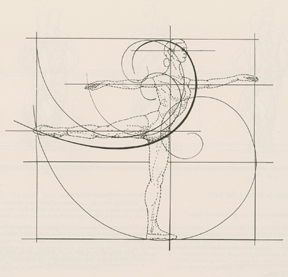
My one real reservation about most print ballet dictionaries is their puzzling lack of illustrations. Though some do have line-drawings or photographs (usually grainy, black-and-white), these are often less helpful than you might hope. However, there are exceptions to this: the Royal Academy of Dance has a book-version of its syllabus with good line drawings that can be quite helpful, while Lincoln Kirstein's Classic Ballet, with over 800 drawings by Carlus Dyer is widely thought to be the classic illustrated book. As the illustration here suggests, there is an element of Leonardo-esque idealism to the book. But all those swooping curves do make for fantastic visualizations.

The one thing that neither the print nor the digital resources seem to be able to help me with is  reverse-defining a step. That is, identifying a step that I have seen, but do not know what to call. For example the other day I was watching this video of the "female variation" from Flower Festival at Genzano:

I wanted to know the name of the step that Natalia Bolshakova makes repeatedly between :43 and 1:00, where she does a jump that begins with a degage-envelope, and ends in plie pointe tendue devant. What is that? So far, nobody has been able to tell me, though they all go, "Oh, that's a great step... we should do that more!" I agree, but we need a name for it.

So if you can help me out here, please, illuminate me. I'm sure that anyone who is a REAL balletomane or ballet professional will know exactly what it is, but I'm stumped.

Friday, November 6, 2015

Plié in first


 Recently, I taught my first ballet class. I have taught all sorts of things in my time; I have been a certified ski instructor, a Red Cross swimming instructor, an SAT coach, a rowing coach, and, for the last twenty years, an art history teacher. Despite this, I did not go calmly into my first class as a ballet teacher.

The voice in my head kept saying, “Come on, who do you think you’re kidding? You were never even good enough to be a professional at the lowest level!”

I told the voice to shut up, reminding her that I was also not an Olympic-caliber skier (in fact, I never won a single race), or swimmer (I was always in the “slow lane”), and even my SAT scores weren’t perfect. Certainly, as an art historian, I do okay, but mine is not the name on everyone’s lips when asked to “name a famous art historian.” (But whose is, outside the little world that is art history? Probably the most famous art historian out there is that squid-faced guy, Zoidberg, from Futurama).

So, I steeled myself. I bought a new CD of ballet-class music (Ballet Divas – piano arrangements of pop-songs ranging from “Holding Out for a Hero” to “You’re Still the One”). I got a fresh notebook and wrote out the combinations and track choices I had made. I re-read most of Agrippina Vaganova’s Basic Principles of Classical Ballet. I made flyers and announced the class on social media.

And nobody showed up, except my fourteen-year-old daughter, whom I forced to come with me to that first class. After tendus, she was fed up with my corrections, and went off in a huff.

For two weeks, I had the studio to myself. That was okay; I used the time to work on a variation I am learning, and to practice things I’m so bad at that I don’t like to do them in class, with other people watching (brisé vole, anyone?). But I felt sad and rejected, all the same.

Then I decided to move the class an hour later, and last week, when I had basically given up on the idea, five whole students showed up. All of them were beginners, though some had a little ballet experience, or had danced as kids. All were actual adults and not just teenagers getting a late start. The whole reason I wanted to teach this class (which is free – I’m not experienced enough to charge for my instruction, in my view) was to give people curious about trying ballet but intimidated by even the relatively mellow atmosphere of the teen-adult classes offered by the ballet school in town. Older people, people who feel like they have the wrong body type for ballet, people who consider themselves awkward, people who do not want to wear pink tights EVER… these people are my target audience.
No thanks!

Ballet, it must be admitted, has a tendency to scare people. Whippet-thin women who actually look good in skin-tight white leotards and flesh-toned tights, heads held haughtily upon their long necks, swan-like arms and gazelle-like legs giving them a preternatural grace that makes the ordinary human feel lumpen and clumsy can be intimidating. The obscure, French vocabulary of the art form puts people on thin ice – many a well-trained dancer I know still struggles to say “développé” correctly (DEV-loh-pay being the most common American pronunciation). Also, ballet asks the body to do things that it just does not do, in the common choreography of most people’s lives; turnout is weird, walking toe-to-heel even weirder.

Understanding this, I want to open the door to ballet just a little wider and let the people who have been standing there at the threshold, hesitating, step inside, even if they never get much farther than one foot in the studio. Actually, I’d love it if I could also lure in some people who don’t even want to approach the threshold, but who might actually enjoy it if they gave it a try. But then I would have to trick them into coming by calling it something else, such as, say, “dancercise.” Euch.

The first question with beginners is how to begin. Something I read in Vaganova struck a chord with me; she says (here I paraphrase) that we begin with first position, and we call it first position, for a very good reason. It is not the easiest position (that would be second), nor is it the most difficult (a fully closed fifth), but it is the position in which we are most aware of the body’s relationship to the space in which we dance, up/down, left/right, forward/back, because it aligns the body symmetrically relative to these directions. With the legs rotating towards 180 degrees from the hip, the lateral axis enters the body. The head, neck, spine, and pelvis stacked above the heels manifest the vertical axis. The squaring of the hips and shoulders, the forward gaze, and the rotation of the inner planes of the legs towards the front engender an awareness of the third dimensional axis (front-back). The plié in first, Vaganova informs us, constitutes the fundamental building block of the whole art form. Everything else you will do, every tour en l’air, every grand jeté, begins here.

A whole hour-long class entirely devoted to the plié in first position would only interest a ballet-geek like myself. I very much doubt that it would seduce a group of adult beginners. So, while I did spend quite a bit of time playing around with the idea with my five brave students, I did not only do pliés in first. We did, however lie down on the floor, on our backs, let our extended legs fall into our natural degree of turnout, and do what I call “air pliés” – that is, pliés without any weight-bearing.

I learned this exercise from a somewhat zany, seventy-five-year-old former Martha Graham dancer last summer. At first I was annoyed to have dragged my tired ass all the way out to Bethesda just to lie on a dirty floor and do endless knee bends, but then as she began to talk about how we should not think of bending our knees, but rather of lifting the long muscles of the inner thighs up towards the ceiling and towards our heads, something clicked. The great thing about doing pliés while lying on one’s back on the floor is that all the stuff that gets wobbly and uncertain in the upright position goes away, and one’s brain can totally tune into the fundamental muscular process without a bunch of static.

In Inside Ballet Technique: Separating Anatomical Fact from Fiction in the Ballet Class, Valerie Grieg writes that two things – an understanding of the anatomy and kinesiology of specific dance movements, and an ability to visualize the correct muscular sequences – lie at the heart of the dancer’s discipline. This plié on the floor thing is a perfect illustration of that – once I’ve done it a few times, when I get up to plié at the barre, I feel hyperaware of the muscles that should be doing the active work, and I can see, in the mirror, that my whole form, meaning my alignment in the three axes, has vastly improved.

I wanted my adult beginners to feel this confidence in their first pliés, and I think it actually did work, because even the student who had never taken a single ballet or dance class in her life and who described herself as ungainly took her first pliés with remarkable aplomb (and I am using the term as it specifically applies in ballet – carriage, assurance of movement).

Alignment is of course fundamentally important – adults in particular can injure themselves so easily if they attempt to dance ballet steps in poor form. However, I want my students also to enjoy dance and to feel like real ballerinas (they were all women, no surprise). So the other thing we worked on (as we did tendus, degagés, ronds-de-jambe, and a little port-de-bras combination in center) was interpreting the music, and not being afraid to be a little schmaltzy. I mean, why not teach them that instead of just holding one’s arm rigidly à la seconde, one can breathe through the arm, let it flow a little, let the head follow the hand? They are grownups, after all, and they want to dance, not just perform a routine set of calisthenics.

In order to encourage them to let themselves go, expressively, I gave them the visualization that my fantastic teacher in Pasadena, Patricia, proposes. Imagine that in your hand you hold either a perfect latté, a dry martini, or a Platonically ideal glazed doughnut (whatever is your poison). You gaze upon it in rapture, never letting it out of your sight for a moment, except when in the allongé positions you pause to contemplate the perfect, sparkly diamonds you wear as rings upon every finger… This adoring absorption can of course be carried to extremes – in real-life dance situations, one sometimes looks at another dancer, or spots a turn, or even gives the audience a bold and saucy glance, but the adult beginners got it – I caught a few of them looking longingly at their own palms as they performed the final port-de-bras. And as far as I’m concerned, that’s ballet.


Sunday, June 28, 2015

Big and Small


I am coming to the end of a two-month stay in Washington DC. The time has passed quickly for me, and it has been productive in terms of my work; three chapters and an introduction to my book finished, two more taking firm shape, a clear sense of how the whole thing will look in the end. But all work and no play makes Grownup Bunhead a dull girl, so I have also been drinking deep at the wells of culture. Museums, performances… even a major league baseball game. And of course, dance, doing and seeing it.

Dancing on the bar!
I had the opportunity to see the Royal Ballet perform at the Kennedy Center early in June. The program was Don Quixote, which has never been my favorite ballet, but it’s one of the RB’s signatures. This particular production featured Carlos Acosta’s take on the choreography, and on the whole, it sizzled like no production I’ve ever seen. Instead of a long, hammy prologue with endless antics by the Don and Sancho Panza, there was a lovely scene between the Don and the apparition of Dulcinea, who floated in on a beam of bluish light in her Romantic tutu with a veil over her head like a Wili. The character dancing was effortless and un-corny, a reminder of one of the things that makes the Royal one of the world’s great ballet companies; they really have fantastic specialists in this under-appreciated area of the art form.


Carlos Acosta, as Basilio, and Marianela Nuñez as Kitri were joyful and great fun to watch. I sat way, way, up in the third balcony, but even at that distance, their energy communicated, and the intricate, precise footwork carried. For the first time in my life, I got through the whole first act without feeling a bit impatient with the endless “come on, everyone, let’s dance for no particular reason” pacing of it. The best scene was in the tavern in Act III, when Basilio and Kitri danced on the tables and on the bar – Kitri and the Street Dancer did a very sensuous female pas-de-deux that spiced up what can otherwise feel like a very kitschy “peasants in a tavern” schtick.
Third balcony, a little right of center.

I walked out of the grandeur of the Kennedy Center (and into the grandeur of a truly spectacular evening on the Potomac) with a new appreciation for the scale of Don Quixote – Minkus’ score opened up hugely in that huge space, and the scale of the sets, the complexity of the lighting and scenery effects, and the BIG dancing made sense. Maybe my problem with the ballet before was that I had seen productions that wanted to make it a smaller, more intimate thing; but it has no really compelling storyline or psychological development. Like the picaresque novel from which it draws inspiration, it wanders from one spectacle to the next, from the curious to the hilarious to the outrageous to the bizarre, and you just have to go along with it, which proves easier when the production does justice to the grandiloquence of the concept.

Yes, he is holding her up one-handed.
Oh, and it helps to have some of the best dancers in the world to dance it.

On the other end of the spectrum of scale, Chamber Dance Ensemble, a seasonal company directed by Diane Coburn Bruning, resident now in DC (she started the group in New York). Coburn Bruning is a choreographer with a strong commitment to the integration of dance and music – in her pre-performance talk she made very clear that she will have nothing to do with dancing to recorded music. Her company includes six dancers and four musicians (a string quartet); thus the “chamber” in its name. They performed in the Lansburgh Theatre, a 441 seat theater that was for many years the mainstage for the Shakespeare Theater Company (they now have a larger, more modern theater as well). This small venue suited the size of the company and the chamber music well. The quartet was on stage with the dancers and the choreography had clearly taken this into consideration, since even from my seat, on the left aisle of the center block of seats, which is to say right in front of the quartet, I could see almost everything. I could certainly see the sweat fly off the male dancers when they performed barrel turns!

That's Diane Coburn Bruning on the left, and a few of her company members, including the violist!

The level of technical ability on the part of the dancers and musicians was very high – and the program was very demanding of all of them, especially the violinists. They were only offstage for the first piece, a spoken-word performance work by Ann Carlson, called Four Men in Suits (which pretty much describes the cast). But after that they played an Astor Piazzolla tango, and then the dancers came on for the first piece, which had a commissioned score by Chia Patino and choreography by a young up-and-comer named Darrell Grand Moultrie. The Wild Swans of the title were nothing like Petipa swans – no feathers, no pulsing allongé arms; men and women both, they had an angular, birdy quality that had more to do with the actual behaviors and body forms of these strange, prehistoric creatures than with a romanticized notion of their serene beauty. Not to say that the choreography ignored the whole history of balletic swanning around; there were moments when the archetypical movements surfaced, but only to splash away. The costumes were very subdued, deep violet for both men and women, and even though swans aren’t purple, somehow the color, like wild plums or wild flowers, or a summer sunset, seemed right. The music, too, had this eerie, untamed quality, lots of sighing slides and airy harmonics.

Slightly creepy, very cool.
That music, so shimmery and rustling, flowed right into the next piece, by Arvo Pärt, with Coburn Bruning’s choreography on the three women. Dulcinea’s white veil was diaphanous – even from the third balcony I could see the ballerina’s face vaguely through it. In “Arranged” the women wore much heavier lace veils, white leotards, and nothing else. They sat on a row of seven or eight spindly white chairs placed at an angle across the stage, their bare feet covered by a mound of rose petals. I can’t quite describe what made this such a fascinating piece to watch – they didn’t actually do a lot of movement and the movement they did was very small, very controlled, most of the time. One woman spent probably five minutes holding a modified boat pose (!) while sifting through rose petals with her fingers as the other two did a strange, winding pas-de-deux downstage. But like the music, in which the second violin played the same double-stopped drone the entire time, the restraint of the movement was what kept me interested – the smallest gestures seemed significant.

The second half of the program was as varied and challenging for the performers as the first; a “structured improvisation” for the dancers was matched with an exercise in which the quartet were given a piece of music to play which they had not played together before, or seen until they walked out on stage and were handed the score. Then the two violinists performed a movement from Prokofiev’s Sonata for Two Violins, and the final piece, also by Coburn Bruning, was an homage to her teacher, set to Baroque music, and wonderfully athletic and playful. It reminded me of Balanchine with some of the strings cut loose, a little bit of Twyla-Tharpish zing thrown in. One leitmotif was what I guess you'd have to call the "en pointe slide" -- a dancer would literally skate on the tips of her shoes, like a kid sliding in her socks on a polished floor. Only on pointe. On pointe!

Big ballet, small ballet – they both have their appeal. I think, however, that it is the Chamber Dance Project I will continue to reflect on and draw inspiration from for longer. I will never be a Kitri, nor do I have any desire even to try to accomplish the level of athleticism of the CDP dancers, but there is something in the way that the contemporary choreography embraces the music, the way the dancers, on stage, make eye contact with the musicians, as well as with the audience, that makes me think this is really the future of the art form. Which is funny of course, because it is the past of the art form as well – when Louis XIV danced at court, he did so with his orchestra in the arena with him, not hidden away in a pit. But there will always be an audience, too, for the big ballets – when they’re good, their like a four-course meal with flights of wine for each course, heady and delicious.

Sunday, June 7, 2015

Le roi danse


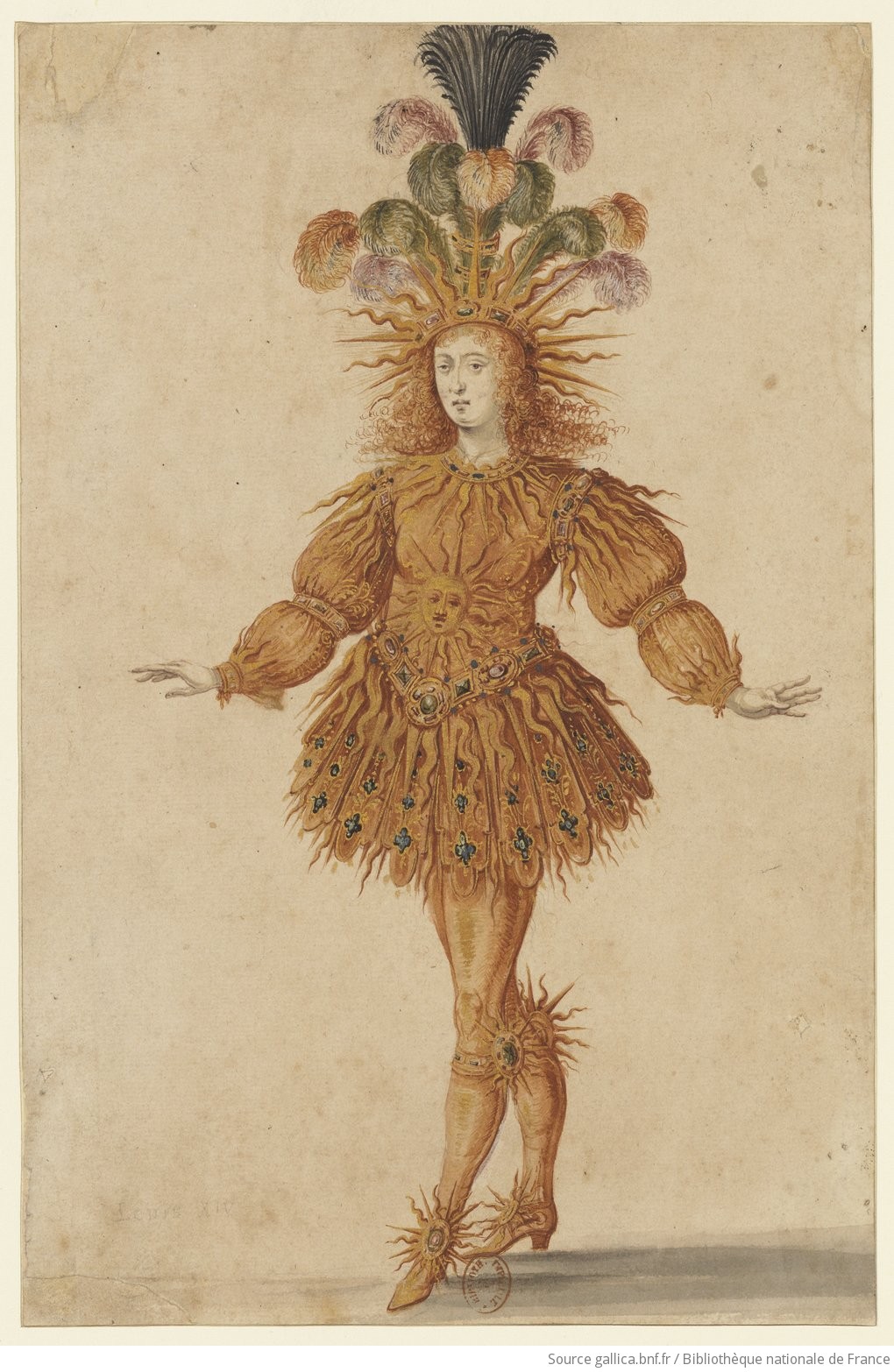
If one knows anything at all about the history of classical ballet, one knows that it began, more or less, with the court dances of the Ancien Régime, in France. In particular, Louis XIV, the brilliant young “Sun King” while a still a teenager raised the art form from polite entertainment to a shock-and-awe spectacle that made manifest his divine election. In 1653, at the connivance of his Italian chief minister, Cardinal Mazarin, he appeared in a suite of dances called Le Ballet de la Nuit, with music by Lully, culminating (as the night generally does) with the break of day, when the king, dressed in golden armor of the Roman style and sporting a corona of golden rays, “rose” from beneath the dancing floor, in the persona of Apollo. 

Gérard Corbiau’s film, Le roi danse, from 2000 is hard to get hold of in the US, but you can at least watch his reconstruction of the thrilling moment on YouTube:  https://www.youtube.com/watch?v=BMvpvDjFvHA. Aside from the slight whiff of fromage it provides quite a convincing picture of how impressive this apotheosis would have been. 

Vaux-le-Vicomte: a pocket Versailles
(for those with deep pockets)
And Louis took dance very seriously; in 1661 he actually arrested (and subsequently imprisoned for life) his finance minister, in part because of a ballet. Nicolas Fouquet had commissioned a work from the great dramatist Molière, Les Fâcheux (“The Unfortunates” or "The Annoying Ones" – a cruelly apt title given what became of its patron). It was performed on a hot August evening in the gardens of his magnificent castle at Vaux-le-Vicomte, and tout le monde attended. The King was the guest of honor. He applauded Molière’s accomplishment, but he was not amused by the pretense of his CFO. Fouquet had dared to rival the king as a patron of both architecture and ballet – the means by which Louis perceived his divine prerogative should be made manifest.
 
But why dance?  It all has to do with power and message. The dancer’s body speaks persuasively, viscerally, and that means that whatever message it conveys exercises persuasive force. An absolute monarch absolutely must control the messages that bodies in motion express. Mark Franko, a dance historian, writes, “In 1661, court ballet was still a vast metaphor for social interaction. In order to exert control over the medium of dance, which was indirectly a control over his courtiers, he (Louis) institutionalized dance by founding a Royal Academy of Dancing.” [Franko, 2015]. 

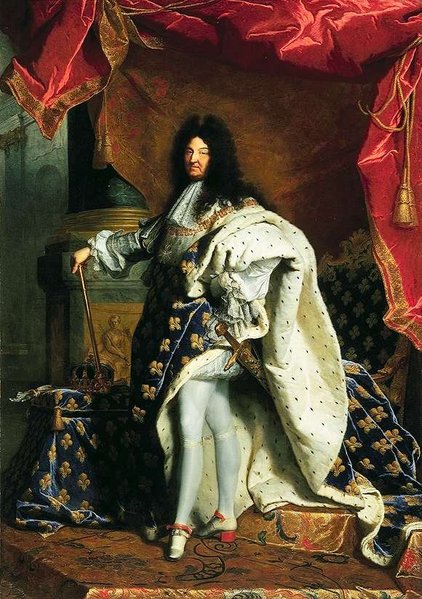
He's got legs and he knows how to use them.
Louis was the Dancing King, and the King of Dance as well (and he had the gams to prove it, as his famous portrait by Hycinthe Rigaud shows). Ballet would not be the same without him. But he was not the only monarch to stake his power on dance performance. 

Today I went to Dumbarton Oaks, a small museum that specializes in Byzantine and Pre-Columbian art. The collection was assembled by Robert Woods Bliss and Mildred Barnes Bliss, a wealthy diplomatic couple, who gave their house (which they had designed with an eye to its future existence as a museum), collections, and gardens to Harvard University in 1940 as “a home for the humanities.” It is a little corner of Paradise in Georgetown. 

The Johnson Pavilion
After spending a very long time ogling the exquisite objects in the Byzantine collection (oh, the jewelry!), I wandered into the new part of the building (the original house is a Federal-style brick mansion); this addition was built by Philip Johnson in the early 1960s, and it is, in true Johnson fashion, more glass and light and air than anything else. It takes the form of a ring of domed pavilions encircling a simple fountain. I overheard a woman saying, “Ah, still more beauty!” as she looked about.

In the pavilion dedicated to the Maya, I eavesdropped while an erudite man explained to his companion the differences between alphabets, syllabaries, and ideographic systems. It turns out that when paleographers are trying to decipher an ancient form of writing, they use basic statistical analysis to begin to understand whether they’re looking at an alphabetical system in which each character corresponds to a single sound, a syllabary, in which character represents a syllable (consonant/vowel grouping), or a pictographic or ideographic system, in which the characters represent whole words. It turns out (according to Mr. Smarty Pants, who sounded pretty credible to me) that if there are about 20-40 frequently repeated characters, you are looking at an alphabet, 40-70, a syllabary, and over 70, usually over 100, an ideographic system. 

When he had moved on I walked over to see what had prompted his little disquisition; and it was a limestone panel, about six feet tall, dense, yes, with Mayan glyphs (which are a combination of logograms and syllabic characters, as it happens). But at the center, almost life size, stands a figure. Or rather, not stands, but dances. His body faces front, though he turns his head sharply to the left, so his face appears in full profile.
Panel
For a zoomable hi-res image go here
Young, lithe, and slim as any Greek kouros, he also shares their suspension between aristocratic detachment and action. 

He lifts one heel off the ground, cocking his knee and raising his hip and shoulder on that side. His corresponding arm also rises, his elbow just a little lower than his shoulder, his hand held up at the height of his head, his fingers curled around the slender, serpentine handle of his very nasty looking axe (I had just been checking out the evil-yet-beautiful jade axe blades in the neighboring vitrine). On the other side, he holds his hand low, by his hip, and in it he clutches some kind of handled pot and a docile-looking viper. According to the museum’s wall label, this little bucket is labeled “darkness” and symbolizes a massive, light-killing thunderstorm.

The glyphs give us his name –  K’an Joy Chitam – and inform those who can read them that here he performs a dance in which he becomes Chaak, the Mayan god of bad weather and blood sacrifice. His parents kneel to either side of him, as the panel has some kind of genealogical significance. 

He wears an elaborate costume. His head-dress, ear-ornaments, necklace, and pectoral seem to be made up of serpents’ coils, turtle shells, and beads. He wears cuffs with inlaid patterns that look a great deal like the flashy golden arm-rings embedded with precious stones that I saw in a case a few yards away. Then he has this pleated kilt of sorts, high-waisted, falling just to the tops of his thighs, and close fitting, showing off the trim line of his waist and the swell of his thigh muscles. Over this he wears a belt with two enormous strap-work bosses over the hips and a long, long, sash hanging down right in the center, pinched between two enormous beads between his thighs, and then descending to the space between his ankles in their striated cuffs. 

I would guess that originally the panel belonged to some tomb or temple complex built in honor of this short-lived king, and that it would have been painted brightly (I’ve watched my share of documentaries on Nova); but even isolated and bare, it conveys a sense of this muscular, lithe, young deity in human form, using his rigorously disciplined body to bridge the gap between this world and that of the gods.

Dance, like other art forms, is instrumental; that is, it enacts, rather than just relates, knowledge, states of being, and power.  Matthew Looper explains the function of dance in rituals of kingship in the Classic Maya world thus, “Such displays did not merely represent rulers’ control over divine forces, but actualized this power, making it real through aesthetically grounded experience” (Looper, 2009).

That the human brain has some intrinsic aesthetic capability, similar and perhaps related to the capability for spoken language, has emerged from recent neuroscientific research, so that perhaps now people will begin to take seriously what humanists have been insisting ever since Kant (at least), namely that aesthetic experience is substantive, real and powerful. Although I cringe at any universalizing theory that seeks to put all humanity in one tidy explanatory box, I would like to think that K’an Joy Chitam and Louis XIV would have recognized themselves in one another despite the vast gulf of time, space, and culture between them. For both, the body of the king in all its youthful virility, its splendidly costumed pomp, its skillful, technical command of precise movement, made real and present their special relationship to their respective deities.

Perhaps Merce Cunningham said it best: “If a dancer dances – which is not the same as having theories about dancing or wishing to dance or trying to dance or remembering in his body someone else’s dance – but if the dancer dances, everything is there. . . Our ecstasy in dance comes from the possible gift of freedom, the exhilarating moment that this exposing of the bare energy can give us. What is meant is not license, but freedom.” So maybe that is why the king must lead the dance... otherwise, people might think that freedom belongs to them!

To read more about the Dumbarton Oaks dancer:
Matthew Looper, To Be Like Gods: Dance in Ancient Maya Civilization, University of Texas Press, 2009

For more on Louis XIV and ballet:
Jennifer Homans, Apollo’s Angels: A History of Ballet, Random House, 2011
Mark Franko, Dance as Text: Ideologies of the Baroque Body, Oxford University Press, 2015