Friday, January 3, 2014

Back to the Barre


Barbara Morgan, Martha Graham and Erick Hawkins
at Bennington College, 1938. Silver gelatin print.
Haggerty Museum, Marquette University, Milwaukee
 

The Bunhead has been on ballet vacation for three weeks and it is just about killing her. Okay, she did a little home-cooked version of barre and lots of stretching and sit ups over the holidays, but the number of cookies, slices of tart, and second helpings of all-too-delicious dinners far outstrips the number of pliés and tendus, I fear. Most winters, I have turned to my sizeable collection of workout videos, but because we recently moved our television into a room with a large picture window that faces the street, I no longer feel comfortable working out in front of it. And, let me be frank, I hate workout videos. There, I said it.

Monday, however, signals the resumption of ballet normality, and it simply cannot come soon enough. Somehow, shopping for leotards online does not give the same satisfaction as sweating through grand allegro in the studio.

In the interim, I have tried to do some reading about dance. Joan Acocella has an article in this week’s New Yorker about talent, new and old, choreographic and performative, at the Alvin Ailey Company (http://www.newyorker.com/arts/critics/dancing/2014/01/06/140106crda_dancing_acocella ).  And I just pre-ordered CarlosAcosta’s first novel, called Pig’s Foot from Amazon for my Kindle (makes reading while husband sensibly sleeps feasible). We shall see! 

Also, I bookmarked both Dance Magazine and Pointe, and started reading articles there. Three things I have learned are:
 1.      Rolling on one of those foam cylinders before you stretch can really help break up adhesions and loosen fascia, making one more limber. 
2.      Wendy Wheelan is only a year younger than I am (!) 
3.      These are not really very profound sources of information or criticism about the dance world; while more substantial than say, People, they are a little on the fluffy side.


 # 3 sent me looking (on JSTOR, Project Muse and farther afield) for better, more in-depth things to read. I found that Carol Lee’s Ballet in Western Culture: A History of Its Origins and Evolution  was oft-cited, so I think I will find a copy of that to plow through at some point.  

Inspired by a free copy of Dance Research Journal that I acquired at a publisher’s bookstand at a conference last year, I also browsed through back issues. My favorite is Volume 42, number 1, Summer 2010, a special issue dedicated to “States of the Body.” In it, an article by Henrietta Bannerman (whose author biography states that she “is head of research at London Contemporary Dance School” and has a PhD in Contemporary Dance… wow, they actually take dance seriously over there in the UK) entitled “Martha Graham’s House of the Pelvic Truth: The Figuration of Sexual Identities and Female Empowerment,” really caught my attention. 

Evidently, Martha Graham’s company members and students facetiously called her studio “the House of the Pelvic Truth,” a phrase coined by Graham, more seriously, to describe the way in which she conceptualized the “seed” of her movement vocabulary. Bannerman relates her own experience as a Graham student of coming to terms with the floor exercises that emphasized contraction and release. I remember feeling so embarrassed when we were instructed to do those pelvic thrusts in modern dance class when I was an adolescent. I wish someone had explained the purpose of the drills to me then as lucidly as she does. She writes, “Within the neutralized context of the dance studio, one aim of the contraction during the floor work is to sensitize the body for emotional expression—the acts of laughing, sobbing, anger, fear, but not necessarily sex.”

And sometimes a pelvic thrust is just comical.
One thread that runs through the scholarship  in DRJ is iconology, that is, the assumption that the forms of dance are symbolic, meaning rich, socially embedded, and (probably also) unstable. Bannerman’s ultimate argument, it seems to me, is that while there is something distinctly louche about the phrase “house of the pelvic truth,” in fact Graham’s modernist project is far more sophisticated than much of the reductive reportage tying her sexuality and her libidinous activities to her choreography and her technique might indicate. Sometimes a pelvic thrust is erotic, indeed, but just as often, it alludes to grief, to budding self-awareness, to determination in the face of adversity, all depending on context.

Ballet, of course, has an entirely different relationship to the pelvis, which is less engine than fulcrum of movement. I like to think that in classical ballet the pelvis is the point of caesura between the dense and complicated prose of the legs and the lyric verse of the torso, arms, neck, and head. Its stillness is not passive, but purposeful, and in its way just as expressive and allusive as the dynamism of the Graham pelvis. 

Snap! Crackle! Pop!
As for me and my pelvis, I fully expect those first pliés on Monday night to be crepitous, as I contemplate whether I ought to have rolled on my foam cylinder some more before class and marvel that Wendy Wheelan, at nearly my age, gets up and does this every single morning, and all day long. I doubt very much I will be thinking of the emotive, expressive potential of my hips, sacrum, or any other body part. Instead, I will be ruefully remembering all those second helpings and gingerbread biscuits and slices of Brie, and wondering if just maybe that leotard I ordered online will arrive by Wednesday night’s class.

Monday, December 16, 2013

Dancing on the Sacred Ground (highbrow dance on TV)

I went to college in western Massachusetts, but at that time in my life I was very far away from dance, trying to get it out of my system (but still doing pirouettes in the kitchen when no one was watching). This really is a shame because it means I never went to Jacob's Pillow, never applied to work there as a summer intern (or a cook), and thus I missed out on the opportunity to see, just to name a few:

 
The opening and closing image of the documentary
  • Laura Dean 
  • Mark Morris
  • Hubbard Street Dance Company 
  • Judith Jamison  
  • Bill T. Jones/Arnie Zane & Company 
  • Merce Cunningham
  • Trish Brown


The list goes on and on. Fortunately, by the time I went to graduate school I had come to realize that one could go and be in the audience at a dance performance and not spend the whole time feeling regretful. Berkeley brought in a lot of good companies, and student tickets were if not cheap relatively affordable.

But I missed Jacob's Pillow, and for that I am sorry. I just watched this very well made documentary from Dancing at Jacob's Pillow -- Never Stand Still that aired last summer (but that is still streaming on the PBS website) that follows the history of the site and has tons of fabulous footage of performances, workshops, and rehearsals by dancers of every stripe. What really struck me was how "the Pillow" becomes a kind of United Nations of movement, with everything from experimental approaches to Brazilian social dance to multimedia performance art, classical ballet to slapstick (Bill T. Jones narrates).
That's my kind of place.


To me it sounds like heaven on earth, a place to live and breathe dance amidst the not-inconsiderable beauties of the Berkshires, a place where the audience is likely to be as possessed by dance as are the dancers. I think one might have to go back to Greek theater to find a parallel situation where the performers and the audience alike are essentially votaries dedicated to something much bigger than themselves, something powerful and weird and transporting

The word that springs to mind, listening to Suzanne Farrell or Paul Taylor, or Judith Jamison, or any one of the other luminaries interviewed in the film, is enthusiasm. They are deeply, seriously enthusiastic in its primal sense,of rapturously possessed by a force larger than the individual self. And dance does inspire that kind of ecstatic devotion; this is just as true of Abby Miller and her crew of dance moms as it is of whirling Dervishes, though in very different ways.

Because too much is never enough when one is an enthusiast, I also had to watch this Great Performances film of Paul Taylor Dance Company in Paris, which aired last spring. I saw them once at Zellerbach Hall, and I do not remember the program but I do remember walking away feeling stunned by how effortlessly his dancers seemed to produce movement at extremely high voltage for sustained periods of time. The first half of the film features Brandenburgs, which he describes in a little interview segment as being about "gallantry."

It is (of course) set to Bach, and who can resist the Brandenburg Concertos? Well, not I, anyway. The costumes must be mentioned too; they were designed by Santo Loquasto and they are absolutely perfectly in harmony with the choreography, the music, and the serious fun of the piece. The materials are rich and velvety, trimmed with gold, but not ostentatious or flashy -- both in cut and hue they remind me of later sixteenth-century court dress, with its somber colors and austere tailoring belying the incredible expense of the materials. The colors, too, seem at once sober and sumptuous; all of the dancers wear jewel-like greens ranging from peridot for the main male dancer, to deep emerald for the male corps, and a sort of mossy, dark jade for the three women, whose skirts must be cut on the bias to move as they do, like water.


Parisa Khobdeh
As for the choreography, you really just have to see it. Taylor is so adept at striking a balance between the classically trained bodies of his dancers and the vocabulary of "classic" modern dance while also throwing in these wonderful little cadenzas of more vernacular, almost Buster-Keatonish awkwardness. So, for example, in the final ensemble movement, the dancers are arrayed on the stage in a echt-Petipa inverted wedge, doing classical pirouettes and beaten jumps at a staggering pace (well, I would be staggering), throwing in a sequence of Graham-esque semi-contracted développés (while turning, natch), and then they suddenly interject this funny little phrase that I can only describe as wobbling like a Weeble, all while grinning broadly. They are having so much fun that I wanted to do a sort of Alice-through-the-flatscreen thing and join them up there. Whooooheee!

Michael Trusnovec clearly never works out.
What amazing artists. And they are also among the most beautiful people I have ever seen. The lead male dancer, one of Taylor's stars, is Michael Trusnovec, and though his official biography on the company's website claims that he is from Yaphank, on Long Island, this must be wrong. He was actually not born, but carved from marble and placed on the pediment of a mid-fifth century BCE temple to Apollo, but at some point got enthused and now appears to have more muscles, sinews, and contours in his chest, back, and abdomen (he is shirtless) than anatomically possible. Meanwhile Parisa Khobdeh claims to be from Plano but looks like she walked in through the door from Middle Earth, where she, and not Liv Tyler, was the real
Arwen.

The second half of the program is a ballet dedicated to Walt Whitman, and featuring the music of Poulenc. Very different, but also very moving. Watch these films! You will not feel you have wasted your time.

Sunday, December 1, 2013

Cracking the Nut


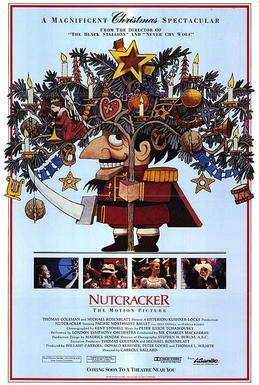
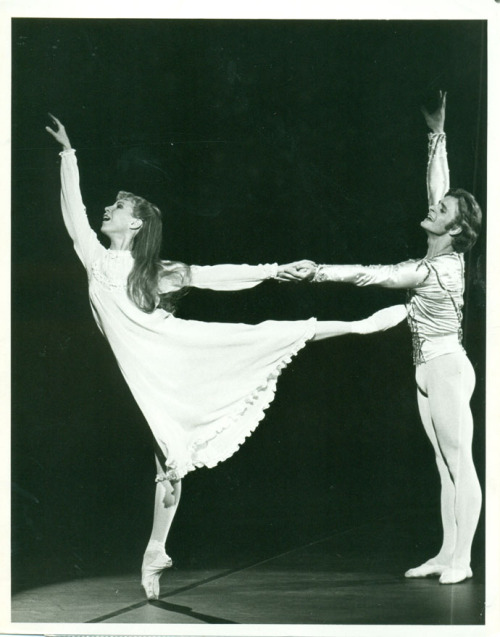
My musicologist friend Chris once related to me this theory that his doctoral advisor has about Tchaikovsky’s score for the Nutcracker, in which the musical themes of the Grand Pas-de-Deux and the final Waltz and Apotheosis indicate the death of the young heroine. Now I have seen many and many a Nutcracker, ranging from the haunting, pared down Baryshnikov/ABT rendition captured in the 1977 film starring MB and Gelsey Kirkland, to the very traditional and true-to-libretto, Royal Winnipeg account, to the kooky, Sendak-designed PNB extravaganza, to Mark Morris’ Hard Nut, as well as multiple performances by different companies of the more garden variety version. And in not a single one of these various accounts does Clara/Marie expire. Well, maybe with Baryshnikov she comes close – the Grand Pas-de-Deux there is so erotic and swoony that one thinks perhaps that Clara is experiencing the little death, if not the big Death. And then she floats away, thanks to movie magic.


So I started to wonder, as my Thanksgiving-induced brain fog subsided, was this deathliness and darkness in the original story? And could Tchaikovsky have been responding, in his music, to the written text?
 
 E.T.A Hoffmann wrote the ersatz fairy tale of “The Nutcracker and the Mouse King” in 1816, at the
height of the Romantic era. I had always thought that this was the source of the ballet libretto, but in fact, a short and not very scholarly search through the literature on the Nutcracker (which turns out to be fairly substantial) reveals that this is not the case. The story was translated into French and adapted to the more bourgeois and staid tastes of mid-nineteenth-century Paris by Alexandre Dumas (père); he took out the really weird parts and toned down the original’s ambiguity, according to most of the things I read. It was his version that Petipa liberally adapted in creating the libretto for the 1892 ballet.

Whether the heroine is Marie Stahlbaum (as in Hoffmann) or Clara Silberhaus (as in Dumas), or some compound of the two, all the ballet versions that I know of, except for the PNB/Sendak account, cut out the long flashback, as told by Drosselmeyer to Clara/Marie, of the Nutcracker’s tragic origin, and get straight to the business of his wounding by a jealous Fritz (transformed into a naughty little brother from the older playmate of the Hoffmann story), his close run battle with the Mouse King, Clara/Marie’s heroic intervention, the passage into a wonderland via a snowy woodland, and a long, happy display of visual candy before the dream dissipates and the little girl awakes in the real world, very much alive. 

I would have to re-watch the 1977 ABT film (no penance there) to be certain, but even that version ends with the implication that she wakes from a wonderful dream sad, but not dead. In the PNB version, which retains the story of Princess Pirlipat as well as other elements of the Hoffmann tale not featured in the standard ballet libretto, Marie (played in the party scene by a little girl, but in the end of Act I and throughout Act II by a prima ballerina), returns to her childish form, and wakes up disoriented and dismayed, but very much alive.

In several versions I have seen, Drosselmeyer is played with a certain, serio-comic, creepiness that extends to his relationship with the pre-adolescent heroine (especially noticeable when the adult, but childlike Kirkland dances Clara); the taint of inappropriate sexual desire lends an acid undertone to the cloying sweetness of the ballet, with its sugarplums and bonbons galore. The story, in its bare outlines, could always be read as a  parable about a young girl’s first love and her coming of age; Clara/Marie discovers her agency (by throwing her shoe at a mouse), conquers her fears, saves her prince, and enjoys the rewards.

For PNB’s version, Sendak and company went back to the Hoffmann story for inspiration, rather like
redactors of the Bible going back to the Aramaic and Hebrew sources. Clearly, they found something there that suggested to them this transformation. While Marie is played in Act I Scene I by a child (albeit a fantastically talented child), when she rises from her faint at the end of the battle in Scene II she is an adult. To me, that’s the ballet responding to the Hoffmann original’s strange treatment of its heroine. At the beginning Hoffmann tells us that Marie is the youngest of her family of three children, and that she is seven years old. However, somewhere in the course of events, she becomes the “lady” of a medieval romance, loved and desired by the Nutcracker Prince, who prefers to wear her favor into battle, and who ultimately consents to marry him, in his human form as the nephew of her godfather. Or does she? The line between the child’s imagination, reality, and allegory fluctuates and dodges in Hoffmann’s story; the reader is never quite allowed to know where she stands.

But the death thing? I listened for that this time, while the Sugar Plum Fairy and her Cavalier spun about, smiling so hard you might think their faces would crack. In comes the harp, with a series of rising and falling arpeggios, and then the strings, cascading down, lilting, aching. Yup. Something tragic there. The second theme, introduced by the oboe floating in way up high, followed by the clarinet answering, is absolutely delicious, but not like a sweet. Rather, it’s a clear, slightly fizzing drink, a little intoxicating… very quickly this becomes a swoony, big-moment, full on Romantic swell of musical feeling, with the strings urging everything forward and the horns and the tympani crashing out affect, the piccolos twittering in distress, and then finally it all wraps up with a big drumroll and some blasts from the brass. So is this death? Or that other thing so often compared to death? Or just the way a child feels when the dream of total self-indulgence is shattered by the intrusion of the real?
 
I am not a musicologist, so I am just going on intuition, notoriously misleading here, but I would have to
say that Tchaikovsky is definitely giving us the end of something big. The waltz that follows immediately upon the Grand Pas de Deux is almost manically cheerful, as if it is trying to banish all that darkness and messiness and humanity from the ear and replace it with a big, showy wedding cake. But I do like the way in the ABT film that Baryshnikov made the Grand Pas a lovers’ duet into which Drosselmeyr intrudes, ending the enchantment; all this cannot last, he seems to say.

Which takes me back to Hoffmann’s story. There love and beauty are inexorably linked to suffering, as when her godfather tells the little girl, who is beside herself at being called a liar, “Dear Marie, you were born a princess like Pirlipat, for you rule a bright and beautiful land. But you will have to suffer much if you are to look after Nutcracker, for the Mouse King will pursue him in every land across every border.” 

His prediction proves true – the Mouse King is not above extortion, appearing to Marie at night and making demands. She has to give up all her Christmas candy to protect her beloved Nutcracker, and worse, her sugar dolls, including “Joan of Arc, whom Marie did not particularly care about,” and “a red-cheeked child” who is surely a confectionary version of herself.  The Mouse King even demands that she sacrifice her Christmas dress – which the “Christ Child had given her” – and her picture books. At this point, the Nutcracker, now for some reason bleeding actively like some saintly stigmatic, comes briefly to life to tell her not to keep giving up her pretty things, but instead to find him a sword. 

And even after the Mouse King lies dead, Hoffmann does not let the reader off the hook; Marie may gawp, awestruck and admiring of her prince’s kingdom, but he himself retains a less-than-sanguine outlook. For example, in Gingerbreadholm on the Honey River, he tells her that the people are “nice to look at, but they’re in terrible moods because they suffer from toothaches.”  Rot! Decay! Crankiness!

Even more mordantly, upon the pair’s arrival in the wondrous Confectionary City (which struck me as the pattern for Oz in many ways), Hoffmann gives us a totally bizarre scene, like something out of Dante’s Purgatory, in which a ridiculously assorted quartet of faux-allegorical processions comes into conflict in the city’s central square, before an obelisk made of cake. Just as the squabble is heating up and heads are starting to roll, however, someone shouts out “Candyman!” and everyone falls silent and still, into deep reverie. In a matter-of-fact way, the prince explains that the Candyman is a mysterious power that controls the destiny and ultimately ordains the destruction of all the people of Candyland, and upon hearing the name, the citizens must cease their doings and contemplate  “what is the nature of man, and what is his fate?” 

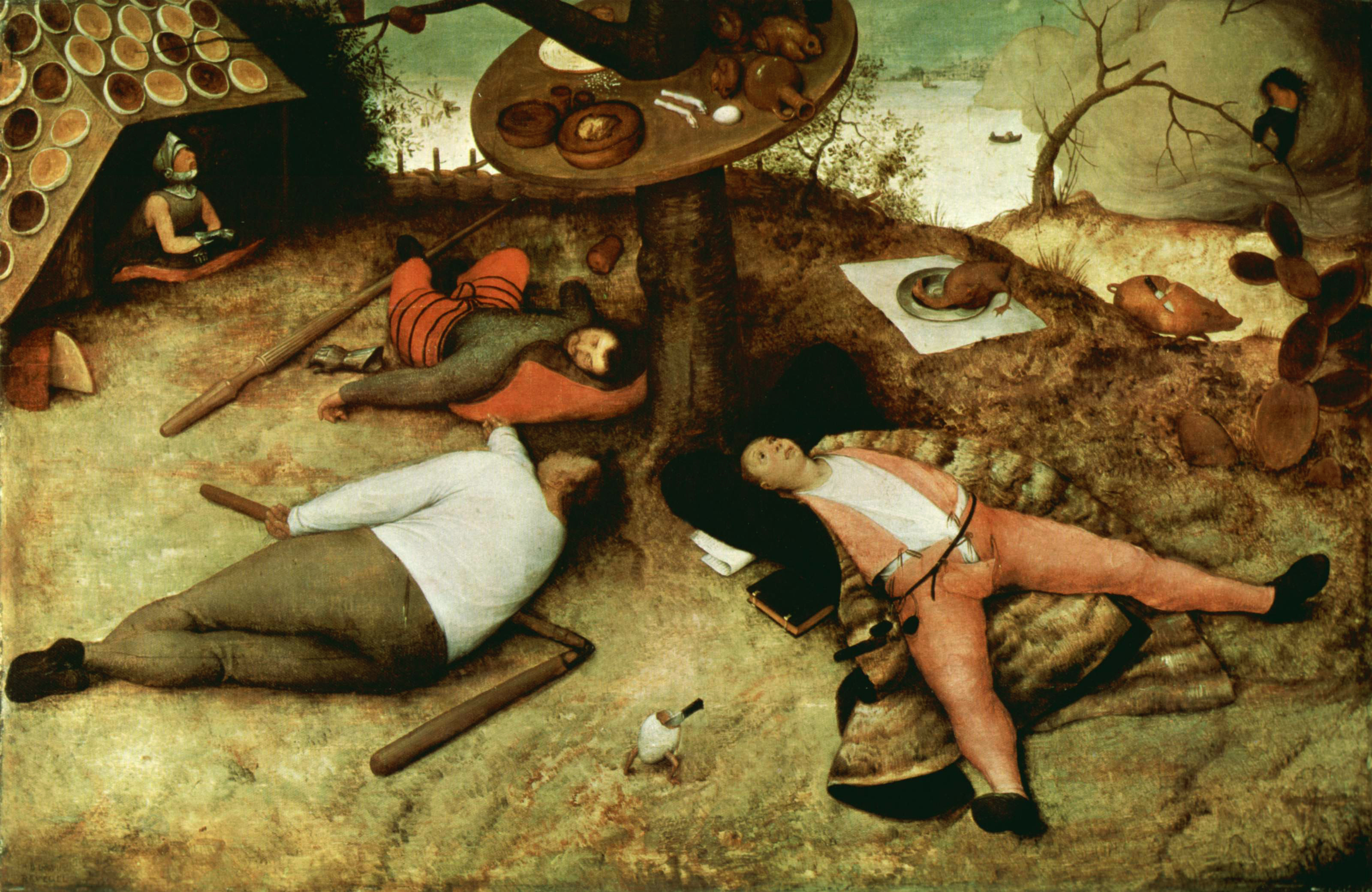
Pieter Bruegel, The Land of Cockaigne, 1567. Sausages and gluttony also figure prominently in Hoffmann's story.
Forces of destruction are everywhere present, while Marie marvels and gapes. In another aside, the prince relates how, not that long ago, the giant Sweettooth nearly devoured the Marzipan Castle, but was deterred by the sacrifice of Marmelade Grove, an entire district of the city. 

The final episode of the story, in which the real-life version of the Nutcracker comes to Marie’s house and proposes marriage to her, reads wry and fey; how old is she? And what does it mean for a little girl from a bourgeois family in early 19th century Nuremburg to go off and rule as “the queen of a country in which shimmering Christmas forests and glazed marzipan castles… can be seen, if only you look”? 

That last statement, which could be read straight as a kind of “believe, dream, fly” kind of cheese-ball mysticism, is in fact probably the trickiest thing in the whole, strange Hoffmann tale. Marie’s kingdom is a chimera, an illusion, visible only to the eyes of those immersed in fantasy, which could be a good thing (the Romantic view) or a dangerous thing (the rationalist view), or simply a thing that screens the real ugliness of the world from view (the pragmatic view, maybe?). In this case, perhaps Marie is really dead, or mad, and Hoffmann is telling us so, obliquely, by saying that you might choose to imagine her absence in terms of ruling a fantastic kingdom, which is nicer, but less truthful.

The Nutcracker it seems, exists to be interpreted. In the words of Newman Levy’s “Bluebeard,” “The ordinary story isn’t gory, it’s a jest!” But the extraordinary story (Hoffmann’s, Baryshnikov’s) seems to mine deep veins of what you might call romantic realism beneath the candy-coating. Love hurts, sweetness harms, dreams disappoint and delude us… now there’s a charming little Christmas story!

Next up for the Portlandia rats? "The Nutcracker -- a Rodent's Eye view"?

Friday, November 22, 2013

Silly Hats and Serious Fun

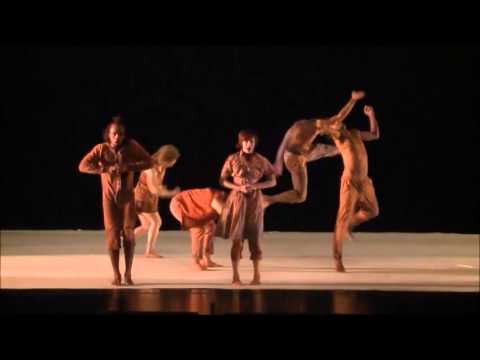
Just back from a performance by Ririe Woodbury, Utah's homegrown modern company, now fifty years old. Amazing athleticism and verve. Six dancers, six pieces, very little downtime.

Okay, now I will start using complete sentences, since Twitter this ain't. It was a treat  to see the company perform in the lovely and intimate performance hall on the USU campus. I've heard a lot of chamber music there, but had my doubts about it as a dance venue. It does not have a traditional proscenium stage, and the floor area is small. For the small size of the troupe and the direct and personal styles of the choreography they presented, however, it worked well. In a physically challenging and complex piece by Ann Carlson ("50 Years"), the dancers provided the sounds as well as the movements, vocalizing rhythmically, and because the Perf Hall (yes, we call it that) is so acoustically sensitive, you could hear every gasp, grunt, inhalation, which gave a deep, visceral rootedness to the whole thing.

Ballet West, Petite Mort
Even if some of the pieces were of a lighter nature, this was serious dance. By this I mean, the dancers and the choreographers clearly approached their art with the intent to communicate something important and to engage with the big questions that dance allows us to ask. What does it mean to live in a human body? What are our relationships, through space, time, and gesture, to other people and to the non-human world? Where do feeling and thinking intersect, and what is the body's role as the vessel of both emotion and intellect? Modern dance, as Adam Sklute remarked at the pre-performance lecture at Ballet West that we attended the other night, can access interiority in ways that are denied to ballet, with its origins in court dancing and the world of public, social performances. Okay, those are my nerdish words, but that was what I took away from his description of the tension between the earthier, modern elements of Jiri Kylian's Petite Mort and the more formal, balletic passages. He did not say this either, but think that in that particular work the modern passages are about sex and the ballet passages are about the rituals that frame sex and civilize it, make it not just animal mating. (I mean, the piece is called Petite Mort, you know?)

Silly hat and silly headgear
But to return to this idea of seriousness, if I may. Ballet West's program included Firebird,  in a reconstruction of the version original to the company (it premiered under William Christensen's direction and with his choreography in 1967). It is not the first Firebird I have seen, nor will it probably be the last. Most people love this ballet-- it has that unbelievably memorable music, for one thing. But really, let us be honest; it is a frivolous thing, perhaps among the most frivolous items in the repertory of most major ballet companies. Act One, the hero runs around in the forest in a stupid hat, and some magic stuff happens. He catches and releases a magic bird with drag-queen eye-makeup. An enchanted princess dances with him. A bad magician and his creepy myrmidons show up. The bird saves the guy in the silly hat. Am I going out on a limb to say that this is not much of a story? Act Two is just a wedding, a group wedding, involving more guys in silly hats. My daughter, who had not seen Firebird  before, got the giggles about the Bishop's mitre. She had never seen its like and had no idea it signified "bishop" so to her it was just a conehead like thing.

The silliness of Firebird has its historical origins in the absurdity of modernism trying to seduce the public by going around with a tarted up folktale on its arm. The problem in 1910, as in 2013, is how to get audiences to come see ballet, and Diaghilev certainly had his finger on the pulse of popular sentiment. Thus, Firebird.

Bayadere: Dance of the Shades
Do not take this to mean I hate Firebird or that I think it is stupid. Not at all; most story ballets are profoundly silly in their narrative structure, their stock of cliched characters, and so forth. As in opera, lovers of the art form put up with a large dose of the ridiculous so that we can indulge our taste for spectacle at the same time we devour the technical and artistic merits of the performance (which are often somewhat divorced from the story). The presence of a ballet blanc in the middle of say, La Bayadere, really makes almost no sense in terms of the supposed cultural setting of the story, but also anchors the whole ballet to the history of the art form and to its essential aesthetic values.

However, really serious dance, it seems to me, has to get at something more than romantic claptrap or faux-folklore. It needs to bite into the business of being human in some really toothy way. I suppose I'm advocating some form of realism, which is tough for an art form based on ordering human movement and human bodies in ways that are clearly not the "workaday" ways that such things operate. But I really saw this seriousness in a few of the Ririe Woodbury pieces tonight, even when they were making me laugh. "50 Years" had the greatest number of passages in which the threads of humor and pathos were intertwined.


This is the cast I saw tonight. For a video, click here.
For example, at one point, the group, which has been moving almost as a single body, vocalizing in ensemble, suddenly breaks apart into a field of individuals, each making self-referential, inwardly directed movements and cawing, semi-linguistic sounds.

There is something comical about this brief attempt to break away from the hive mind, but also something tremulous and fragile about it. At another point, one of the dancers sneezes and all of the dancers collapse, hard, on the floor; the audience laughed, but there was tragedy in the total surrender to gravity as well.

Bill T. Jones. Serious Fun.
The funny thing is that some of the most serious dance of our time (Kylian, Carlson, Morris, Bill T. Jones) is also deeply humorous. I am not talking about inadvertent humor (stupid hats in Firebird), or campy humor (the cheesier parts of a Trocks performance), but real humor, in the Greek sense of a contest between lightness and sobriety, or maybe even between life and death, that exposes the absurdity of life at the same time that it produces a feeling of pleasure in being alive.


Thursday, November 14, 2013

Girl-positive ballet: inconceivable?


Oh no, no, no!

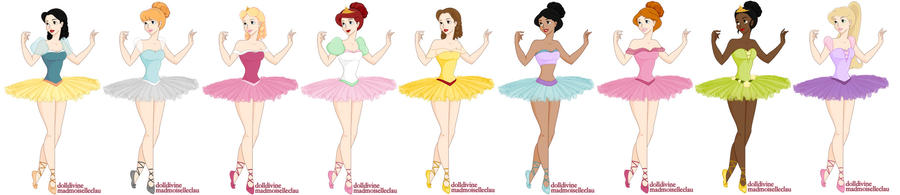
A while ago in response to something I had read about how local and regional ballet companies need more marketable repertoire, I proposed, facetiously, a ballet based on The Hobbit, but this article from the Guardian on Disney’s now-in-development stage play version of The Princess Bride got me thinking; wouldn’t THAT be fun as a ballet? My ballet teacher, a long-time member of our civic ballet, tells me that the company is pretty constrained as to what it can perform and still break even once sets, costumes, and the cost of the theater rental are taken into account (nevermind the dancers… they’re not paid!). Nobody will come see anything strange or unfamiliar (just to give the full sense of what this means… they decided they couldn’t do “Don Q” because the story was not recognizable to local ticket buyers). Basically, they’re stuck with anything Disney has already done as a film, e.g. Sleeping Beauty. Oh, and Nutcracker, of course. They do a mean Dracula some Octobers, and they also have an Ashton-esque Cinderella, an Alice in Wonderland, a Coppelia (a bit challenging for the locals), and a few other things up their puffy sleeves. But, as she noted, it’s tough. As a dancer, she admits to being a weensy bit bored with Beauty in particular. And who on earth would blame her?

So, what about Princess Bride? It has all the classic elements. Princess? Check! Dashing hero? Check, check! Court scenes? Got em! Comic interludes and potential for silly stage business? Fezzik, Vizzini, and Inigo Montoya at your service! But, and this is a big but… there are an awful lot of boy roles and really, in the end, Buttercup is the only girl role worth mentioning. So, maybe not. 
Wuv, twue wuv!

Ballet, as George Balanchine opined, is woman. Or at least, in regional and local ballet companies, ballet is mostly girls between the ages of 15 and 22. So, lots of stuff for the corps to do, some nice solo work for your more accomplished students, and not too many male roles, please. I take a light tone, but it is a real challenge and a serious one if you’re trying to keep ballet alive in a smaller community, such as ours. I have huge admiration for the woman who founded our civic company 30 years ago and has kept it, and the school, together all this time. She must be exhausted. But she doesn't look it.

One of the attractions of The Princess Bride is its humor, and the way it spoofs the conventions of the fairy tale. On the other hand, there’s nothing particularly feminist, girl-positive or radical about it. Buttercup has always seemed a bit of a blockhead, really. So maybe it is no loss that it will not be coming to a ballet stage near you any time soon. 

Which leads me to the question of whether, given that story ballets are the inevitable sustenance of community-based ballet in vast swathes of this country, there are ANY good alternatives to the entrenched, Romantic, anti-feminist tenor of so much of this stuff. Alison Bechdel, the subtly subversive cartoonist and graphic novelist, proposed a test of films for real commitment to their women characters. The test is simple. For a film to be feminist
Alison Bechdel

1. It has to have at least two [named] women in it
2. Who talk to each other
3. About something besides a man

This is hardly a new thing – I think she first put this out in her great cartoon strip “Dykes to Watch Out For,” in the mid-eighties, but recently it has become the meme-of-the-moment and has taken on a life of its own with various media watchers who monitor recent films, track the record of independent versus Hollywood films, look at the historical trajectory of films that do and do not meet this standard… Evidently the Swedish National Film Board has adopted it as a ratings standard.

Many, though not all, ballet stories would fail, even if you replace “dance to each other” and even though for at least two centuries traditional narrative ballet has been mostly populated by women.  Number three would get them. Some examples:

  • Giselle has at least two named women (Giselle, Myrtha, Bathilde) and Giselle and Myrtha do a lot of mime-talk. But, sigh, what do they talk about? Albrecht, the cad! 
  • Raymonda features not only Raymonda, but also her dour aunt, Sybille, her friends (who have names) and the White Lady (is that a name? I’m not sure), and they do a dire amount of pantomime. But, again, it all has to do with men… good ones, bad ones, and so forth
  • La Fille Mal Gardée features Lise, her frustrated parent Simone (does it count when a woman character is played by a man???), and more than half of the stage time in most modern versions seems to be taken up with Keystone Kops pratfalls that pass for communication (or miscommunication) between the protagonists. However, all of Lise’s interactions with her mother focus on their battle of wills about whom Lise will marry… Colas or the buffoon Alain?


Feminist tales are rare enough, and ballet-friendly feminist tales even rarer. The most perfect and simple of all feminist fairy tales, Robert Munsch's Paper Bag Princess features only a girl, a dragon, and a petulant prince named Ronald, so it would not adapt well to the needs of a small company with many little girls eager to go on stage. A friend of mine, maybe it was a Girl Scout camp, had a book called Tatterhood, which included only traditional folktales that featured strong heroines who did not sit around waiting for a prince. 

Lauren Mills, "Tatterhood and Isabella Dancing"
Several of those would make interesting ballets, not least the title tale, from Norway, weird in the way that Scandinavian folktales so often are. It has a queen who, with the help of a witch, overcomes her infertility and gives birth to twin daughters, the elder ugly and fey, the younger beautiful. But the younger sister falls victim to a goblin prank (they steal her head and replace it with that of a cow), and the elder must rescue her (or rather, her head). On their way home after the successful rescue, they are guests of a king and his son. The king falls in love with the younger sister and proposes to her, but she will only marry him if Tatterhood maries his son, and it takes quite a bit to convince the prince to take this ugly, goat-riding, wooden-spoon-wielding hag as his bride. In the end he relents. As they ride home from the wedding (a double wedding! a story-ballet waiting to go nuts!), he is dejected, and gently, Tatterhood manipulates him into asking her questions. Why does she ride a goat? A goat! This is no goat but a beautiful horse! He looks, and it is! Why does she carry a spoon? It is not a spoon, but a silver fan! Why does she wear that dreadful hood? What hood? You mean the golden crown? Why is she so gray and hideous? Me? Gray? Hideous? In fact she is more beautiful than her sister… 

Would this pass the Bechdel test? Maybe not. Except for Tatterhood nobody has a name in the original version. In Lauren Mills' retelling (from which I borrowed the illustration above) the younger sister is Isabella, a good name for a pretty girl. But there is plenty of discussion between women about subjects other than a man. For example, the Queen woos the witch to reveal her secret method of (man-free) conception, and Tatterhood must negotiate with her mother to be allowed to rescue her sister. And ultimately, though it does conclude with a marriage, one has the sense that Tatterhood, and nobody else, is running the show.

I think my daughter would agree... this is not all that inaccurate, at times.
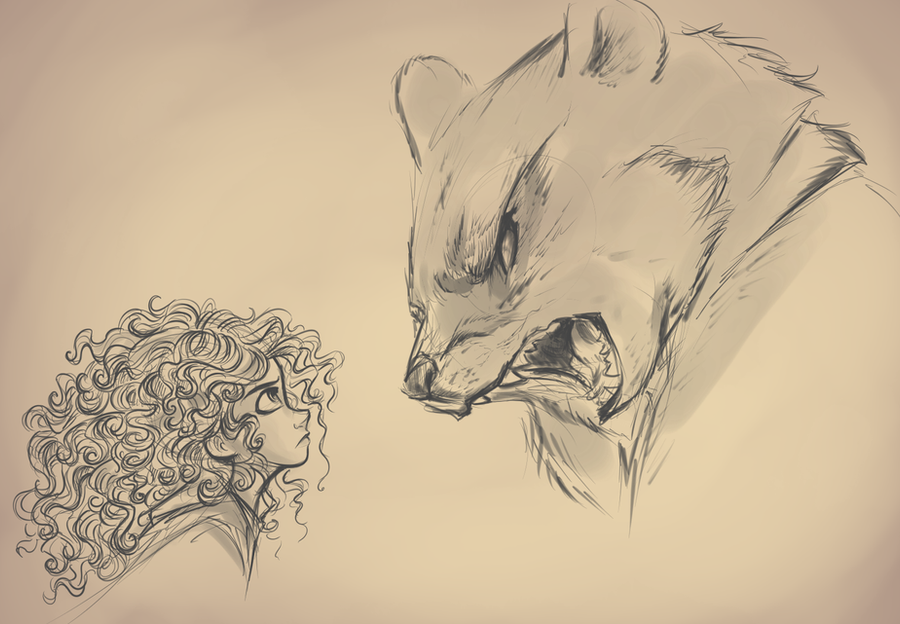
The problem with all this is that Disney has never made Tatterhood into a film and therefore nobody will buy tickets because they do not recognize the story. Once upon a time, I would have despaired that Disney would ever make a film about a girl who pretty much takes charge, and not only that, but does not feel in any way obligated to gracefully resign agency at the very climax of the story (uh, Tangled, Pocohantas, Mulan, anyone?). However, with the most recent entry in the "Disney Princess" genre,  Brave, a twinkle of hope has dawned. There you have a Bechdelian feast – the main romance, after all, is between the girl and her mother, and while their initial interactions do primarily concern either Merida’s marriageability or her potential marriage partners, ultimately, their discourse shifts and they are mostly concerned, painfully, wrenchingly, and horribly concerned, with understanding one another and learning some mutual sympathy. 

The most heartbreaking panel in any cartoon, ever.
Bechdel’s own graphic novel, Are You My Mother? (a follow up to the tragic and yet hilarious Fun Home) covers precisely this emotional territory too, though predictably in a less sanguine vein than Brave. That is to say, Bechdel’s mother never really turns back into a person, having become a bear. But neither does she threaten to eat her daughter... she just stops giving her a goodnight kiss when she is seven. Seven!


From The Princess Bride to Are You My Mother by way of the challenge of dancing to your audience in a small town in the West? Jeez, I love the freedom of the blog format!